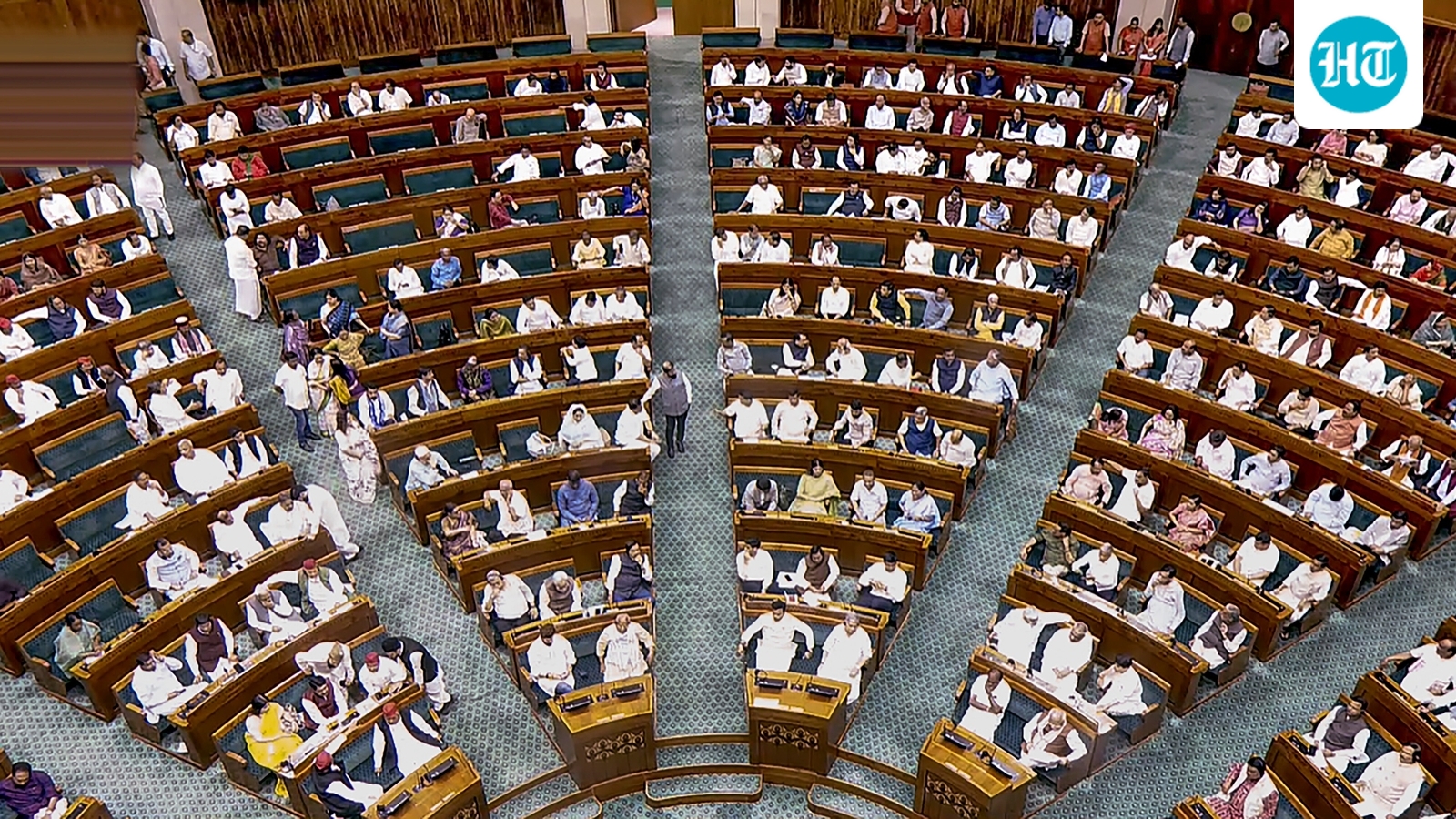
AFter the make-up (131st Amendment) banker's bill, 2026 cut down in the Lok Sabha on fri — the number one defeat of a bill in PM Narendra Modi’s government of 12 years so far — one question cuts through the noise of the political battle: Why can't 33% reservation for women simply be implemented in the existing 543-seat Lok Sabha, right now?The plan, which failed, was to increase the Lok Sabha seats by a flat 50% for now to 816, to a maximum of 850 at some point; and thus give one-third reservation to women as these additional seats are created. The Opposition was up in arms against this seat-increase and delimitation exercise being hastened by using old census data even as larger questions remained unanswered.Legal position of 2023 lawThe 33% reservation for women in the Lok Sabha and state assemblies is already law. The Nari Shakti Vandan Adhiniyam was passed unanimously by Parliament in September 2023, and notified in the gazette just this week, on April 16, 2026, even when a debate on its implementation timeline via an amendment bill was underway. This amendment bill failed to pass the two-third majority test in the Lok Sabha, hence never even made it to the Rajya Sabha. Related bills about delimitation and about application to union territories were never presented once the mother bill failed.Yet, the fact remains that the women’s quota has been legislated already three years ago. It is Article 334A of the Constitution of India.But that law, as written, cannot be implemented yet. It is tied to a specific sequence — a fresh census must first be completed, followed by a delimitation exercise to re-allocate and redraw constituencies; and only then does the reservation come into force.Under this original timeline, implementation would not be possible before 2034 at the earliest as the first step, the latest census, has only just started.The census-then-delimitation-then-quota condition was not something the Opposition asked for, Congress Parliamentary Party chairperson Sonia Gandhi wrote in a newspaper article this April 13.“In fact, the Leader of the Opposition in the Rajya Sabha, Mallikarjun Kharge, had forcefully demanded that the reservation provision be implemented from the 2024 Lok Sabha elections itself. For reasons best known to itself, the government did not agree,” she wrote.The obstacle to implementing reservation on the current 543 seats, on the surface at least, is a condition that the government inserted into the 2023 law. Thirty months later, it wants to remove that stipulation, but wants to use older census data to change the Lok Sabha composition for it.When the 2023 law was passed, Amit Shah told Parliament that a census would be carried out right after the 2024 elections, and that the next government would go in for delimitation soon after. The 2021 Census was already due by then, having been delayed by Covid and other, mostly unexplained reasons.The government now came back in 2026, proposing to use the 2011 census instead. But the Opposition did not agree, on two counts — the question of regional disparity needed to be addressed for the long term first, and the question of a set share for the Other Backward Classes too.The latest census well and truly got underway only earlier this month. A big part of that is also the caste census, being conducted for all participants for the first time in nearly 100 years.So far, only the Scheduled Castes and Tribes (SC, ST) are counted in terms of caste, but there were demands for decades to also count the Other Backward Classes (OBC). That is now being done.Govt's latest argumentDuring the three-day special session now, the government did not provide an express, constitutional argument for why reservation could not be implemented on the current 543 seats.It provided an arithmetical explanation instead. Amit Shah's argument in the Lok Sabha was that if 33% reservation were applied to, say, Tamil Nadu's existing 39 seats, only 13 seats would be reserved for women, leaving 26 open for all. If these seats were increased to 59 in total, 20 would be reserved for women and 39 would remain open. The government’s case essentially means more open seats for everyone, more reserved seats for women too.The government has not argued that implementing reservation on 543 seats is constitutionally impossible. The only legal obstacle is the text of the original women’s quota law of 2023, which Parliament could amend.What Opposition offered, and what remains unaddressedThis is precisely what some Opposition members claimed to be offering.Congress leader KC Venugopal told the Lok Sabha, "You (government) only made the provision that there shall be a census, followed by a delimitation, then the reservation will happen. We never said that. We told, at that point of time only, that we need women's reservation by the 2024 elections.” Leader of Opposition Rahul Gandhi also put the counter-offer rather simply, “Bring that old bill back right now and we will help you pass it for implementation from this second.”Kalyan Banerjee from poll-bound West Bengal — where his party Trinamool Congress led by Mamata Banerjee is fighting a BJP challenge — went further: "If women's reservation is to be given, implement it immediately. There is no need to link it with delimitation. You can bring 50% reservation right now! But you don't want to do that.”Priyanka Gandhi Vadra of the Congress asked the government to “be brave”, and pointed out that some leaders, male ones, would have to let their seats go if reservation comes. “The women of India can take up the responsibility,” she said, smiling. OBC question beneath it allRunning beneath the entire debate is a constitutional gap that no government has yet addressed. That the Other Backward Classes (OBCs) have no political reservation in Parliament or state assemblies. SC and ST seats exist in proportion to their population, mandated by Articles 330 and 332 of the Constitution.The demand for OBC quota — even within the umbrella reservation for women — is not new. It is, in fact, a primary reason why women's reservation remained blocked in Parliament for years. The 81st Constitutional Amendment Bill for 33% women's reservation was first introduced in 1996; and again in 1997 and 1998, but lapsed each time. A 2008 bill during the Congress-led UPA time passed the Rajya Sabha test in 2010, but was never voted on in the Lok Sabha. Political consensus could not emerge.The 2023 women's reservation passed with consensus, and it provides for reservation within the existing SC and ST quota — meaning SC and ST women get reserved seats within the seats already reserved for their communities.OBC women get nothing equivalent, because there is no OBC political reservation to begin with. The Constitution does not provide for that.The demand from the SP, RJD, Congress, and others for a sub-quota for OBC women within women's reservation is constitutionally impossible without a prior amendment creating OBC political reservation.Here's how that can play out:Any amendment for OBC quota requires data first — specifically, caste census data establishing the demographic basis for it. Or even for minority representation such as that for Muslims.The 2026 census, currently underway, includes caste enumeration for the first time since 1931. Its results are likely in two years.And then can related questions like political reservation and delimitation be debated.So far, surveys in Bihar and Telangana show OBCs may be over 50% of India, and get quota in jobs at around 27%.Samajwadi Party chief Akhilesh Yadav said in Parliament, "They (government) are running away from the (ongoing latest) census because the demand for reservations will rise. What if they don't count OBCs and Muslims in half the population which is women? We want Muslim and OBC women to get reservations — this is our demand."By proceeding with delimitation based on the 2011 census — before caste data from the 2026 census is available — the government would lock in constituency boundaries for “10-15 years” without resolving the OBC representation gap, Rahul Gandhi said.Where things stand on women quota nowFor now, the three bills for use of the 2011 Census — for redrawing the Lok Sabha and thus women’s quota as per that — have fallen.The 2023 women’s quota law remains on the books but is not implementable without delimitation.And the delimitation question itself has remained unresolved for 50 years. It was last done in the 1970s, and then pushed for 25 years, twice. Besides the OBC quota demand, there is a more fundamental question that remains unresolved.Southern states fear they would lose proportional share in the long term if only population is used as the basis for delimitation. DMK’s MK Stalin, the chief minister of Tamil Nadu, was for instance the first to burn copies of the latest bills. The fear is that states that actually did well on the national policy of population control and family planning would end up being punished for it, while Hindi-belt states where poverty and population remain high will end up with even more say in Parliament.Amit Shah did say that a flat 50% increase won't change state-wise share, and at the last minute he even promised to write it in the law.By that time, it was too late apparently. The Opposition has demanded that delimitation method, population-as-basis, and OBC quota demands, all of it be debated in detail before any bills are moved.Congress MP Shashi Tharoor said in the Lok Sabha on Friday that delimitation was proposed in haste, “the same haste that you showed on demonetisation”.“And unfortunately, we all know what damage that (demonetisation) did to the country. Delimitation will turn out to be political demonetisation,” said the Kerala MP, referring to the demonetisation of high-denomination notes by PM Narendra Modi's government in November 2016.

Global News Perspectives
In today's interconnected world, staying informed about global events is more important than ever. ZisNews provides news coverage from multiple countries, allowing you to compare how different regions report on the same stories. This unique approach helps you gain a broader and more balanced understanding of international affairs. Whether it's politics, business, technology, or cultural trends, ZisNews ensures that you get a well-rounded perspective rather than a one-sided view. Expand your knowledge and see how global narratives unfold from different angles.
Customizable News Feed
At ZisNews, we understand that not every news story interests everyone. That's why we offer a customizable news feed, allowing you to control what you see. By adding keywords, you can filter out unwanted news, blocking articles that contain specific words in their titles or descriptions. This feature enables you to create a personalized experience where you only receive content that aligns with your interests. Register today to take full advantage of this functionality and enjoy a distraction-free news feed.
Like or Comment on News
Stay engaged with the news by interacting with stories that matter to you. Like or dislike articles based on your opinion, and share your thoughts in the comments section. Join discussions, see what others are saying, and be a part of an informed community that values meaningful conversations.
Download the Android App
For a seamless news experience, download the ZisNews Android app. Get instant notifications based on your selected categories and stay updated on breaking news. The app also allows you to block unwanted news, ensuring that you only receive content that aligns with your preferences. Stay connected anytime, anywhere.
Diverse News Categories
With ZisNews, you can explore a wide range of topics, ensuring that you never miss important developments. From Technology and Science to Sports, Politics, and Entertainment, we bring you the latest updates from the world's most trusted sources. Whether you are interested in groundbreaking scientific discoveries, tech innovations, or major sports events, our platform keeps you updated in real-time. Our carefully curated news selection helps you stay ahead, providing accurate and relevant stories tailored to diverse interests.

No comments yet.