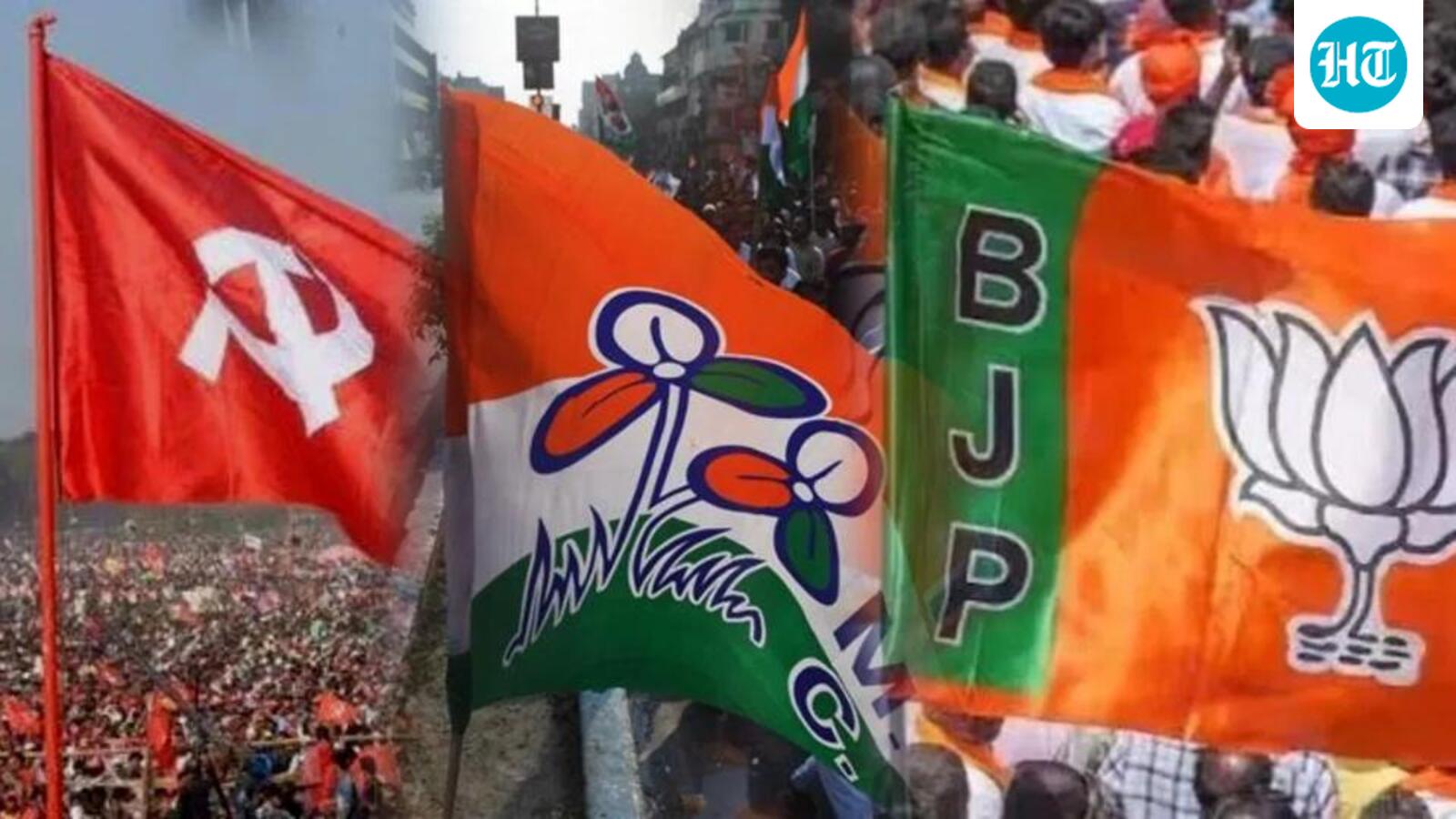
WEst Bengal is a unique say in bharat on a number which is often non comprehended enough. Political power has changed hands only once in the state since 1977. This happened in 2011, when the Trinamool Congress, led by Mamata Banerjee ended the 34-year long rule of the Communist Party of India (Marxist) or CPI (M) led Left Front in the state. The CPI (M) in the state has atrophied for all practical purposes. It could not win even a constituency in the state in 2019 Lok Sabha, 2021 assembly and 2024 Lok Sabha elections. The Bharatiya Janata Party (BJP) has been the main opposition party in all of these elections. Its performance was the best in 2019 Lok Sabha elections when it was just three percentage points behind the TMC in terms of vote share and only four seats behind in terms of number of parliamentary constituencies (PCs) won. The contest was way more tilted in favour of the TMC in 2021 and 2024.West Bengal will finish polling next week. Which way will it vote this time? Making predictions is foolish. We will know the answer on May 4. This column will try and situate the current elections within the larger historical context of West Bengal politics.The narrative of this election in West Bengal is dominated by two factors: the disproportionate deletion of voters in Muslim dominated districts and assembly constituencies (ACs) and unprecedented “sanitization” measures implemented by bringing in central forces, a large-scale reshuffle of the state bureaucracy and unheard-of security protocol including strictures such as people not riding motor cycles. The Election Commission of India (ECI), not the Bharatiya Janata Party (BJP), is carrying out these actions.Let us step aside from the debate around ECI’s alleged partiality for a moment, not to acquit it, but to consider the historical fact that elections in West Bengal have long been a violent affair. The 1972 elections were perhaps the most controversial in the state. The CPI (M) managed to win the 1977 election as an opposition party under very difficult circumstances. The TMC ousted the CPI(M) amid large-scale electoral and non-electoral violence that began with the 2006 agitation against land acquisition in Singur and later Nandigram. The BJP has also developed as a strong political force in the state despite facing large scale electoral violence, especially the local body polls in 2018 and 2023. It is politically incorrect to say this, but no political party can hope to find a foothold in, let alone win, West Bengal without an ability to face political violence and inflict counter-violence. That has been the DNA of the state’s politics for more than half a century now.It is not just a coincidence that the BJP’s main leader in the state, Suvendu Adhikari is Bengal’s proverbial Nelson of the Battle of Trafalgar with a twist. He led the TMC to victory and hegemonic status in the state after the battle of Nandigram where he completely outwitted the CPI(M). Adhikari, however, did not perish like the British admiral and started demanding a share in power from Mamata Banerjee, which she was unwilling to offer.It goes without saying that the party in power in the state will have an advantage on this front compared to the one in opposition. However, this perversion of West Bengal politics should not delude one into thinking that the political contest is only muscle and no popular will or political traction for violence. West Bengal is too large a state for the violence tail to wag the politics dog.The rise of the communists in the state was an ideological victory backed by political violence, primarily carried out by a radicalised and impoverished peasantry. What started as the Tebhaga movement – it literally means the peasant keeping two-third of the produce instead sharing it equally with the landowner – around independence was sanctified under Operation Barga by securing tenancy rights when Jyoti Basu took over as the state’s chief minister in 1977.Once in power, and having delivered on their key promise of land reforms, the communists had the unenviable task of building a status quo within the framework of what political scientist Dwaipayan Bhattacharyya has termed as party society in West Bengal. His book Government as Practice: Democratic Left in a Transforming India is a must read for anyone who wants to understand current politics in the state. The endeavour facing the communists post 1977 almost necessarily entailed depoliticisation and degeneration within the ranks. Critical left intellectuals such as the late Ashok Mitra had flagged this long before the CPI(M) started suffering electoral reverses in the state.What really catalysed the fall of the communists in the state was not ideological decline, but the left government’s high-risk strategy of land acquisition to promote industrialization (and improve mass well-being). The precipitation which Singur and Nandigram triggered, unlike previous flare-ups in the state, finished even the perceived political legitimacy of the CPI (M) and inflicted a shock which completely destroyed it as a political force to reckon with.To be fair to the communists, the ideological predicament which forced them to take the high-risk land acquisition path – namely, failure to usher in structural transformation in a state which was economically stagnating despite being an outperformer in agriculture – is not an easy one to solve. Even states that have performed much better than West Bengal on this challenge realise it has done little to generate remunerative employment on a mass scale.In hindsight, the now marginalized comrades in Alimuddin Street—the West Bengal CPI (M) headquarters that once served as the state’s power center—would be cursing themselves for not having adopted the freebie route to manage political aspirations. This is what their slayer Mamata Banerjee, or their Kerala comrade Pinarayi Vijayan has aced so well. Almost all chief ministers in the country are now following the same script and there is good reason to believe that the electorate gives far more importance to the money which comes in their bank accounts rather than the investment account of the state.The larger economic transformation question in West Bengal, and most of India, has been politically solved by a rearguard action of distributing palliatives rather than the capitalist or communist vanguardism of accelerating private accumulation or eradicating private property. The material basis of Mamata Banerjee’s popularity is not very different from what it is for most chief ministers in the country today. All conspiracy theorists would do well to appreciate this basic fact.The palliative route to power, however, is not the only political economy feature of West Bengal. What distinguishes it from most large states in India is the instutionalised thuggery in how grass root politics operates in West Bengal. While this larger vice has been preserved in the state despite the communists losing power, the TMC has tweaked it into an ideology agnostic, rather opportunistic enterprise to resemble what Dwaipayan Bhattacharyya termed as franchisee politics model in a 2023 paper published in the Economic and Political Weekly. This involves a political praxis where local party bosses (read strongmen) preside over a fiefdom mired in a brutally rent-seeking but not necessarily religiously antagonistic economy in return for providing boots on the ground to the TMC. This dialectic works on the larger political arbitrage of Mamata Banerjee’s provision of doles and to some extent Bengali elite’s regional exceptionalism against what is portrayed as a rabidly non-Bengali national hegemon (read the BJP).The unprecedented security environment surrounding the 2026 elections is clearly an all-out attempt by ECI to defang the TMC’s local franchisees. While it could temporarily constrain such elements, to assume that the TMC’s electoral support is all rigging and nothing organic would be a mistake. Of course, the net impact as far as electoral results are concerned, could be significant in closely contested places. However, the fact that the TMC’s dominance in local body polls (many of these seats are won “unopposed”) has been much greater than assembly or Lok Sabha polls – the former is loosely supervised than the later – suggests that the contest is “fairer” in state and national elections in any case.The last piece of the West Bengal political puzzle is the Muslim vote in the state. It is closer to 30% of the state’s electorate and now overwhelmingly consolidated behind the TMC. Thanks to Muslims losing their bipartisan character in the state’s polity with the rise of the BJP, there has clearly been a large communal polarisation in the state. A basic arithmetic around headline vote share numbers suggests that the BJP actually leads the TMC in the Hindu electorate. BJP’s roughly 40% vote share in a state where Hindus are about 70% of the population, entails a 57% vote share among Hindus, if one were to assume Muslims do not vote for the BJP. While the BJP might see this as a sign of imminent victory, it could also be seen as a sign of having peaked in terms of political support. For example, the BJP’s vote share in Gujarat, a state which is almost 90% Hindu, is about 50%, which suggests about 55% vote share among Hindus.That the SIR exercise in West Bengal included a unique adjudication part which unlike the usual SIR process has led to disproportionately large deletions in Muslim dominated parts of the state, has given credence to the opposition’s allegations of pro-BJP gerrymandering of the electorate in West Bengal. However, as long as the TMC does not suffer a large attrition of Hindu voters, which is exactly what it faced in the 2019 elections, and has recovered after that with economic palliatives, it would be premature to assume something like this necessarily happening this time.A win for the TMC in West Bengal will be portrayed as a political ideological victory over the BJP and its alleged institutional excesses. If the BJP were to win, it would attribute it to the elections being fair thanks to ECI.The actual political fault line in West Bengal, when seen historically, is different and less amenable to convenient or virtuous political interpretations. It is a state which is using economic palliatives to alleviate economic anxieties, has moved from a dogmatically vacuous party society to an ideologically bankrupt franchisee politics model and is staring at a religious fault line which has perhaps never been deeper after independence. The first undermines long-term economic interest, the second makes politics an asphyxiating hold on the society, especially its weakest sections, and the third is ticking time bomb, which if it were to explode, can cause unprecedented disruption and damage to the social fabric of one of India’s largest states.The ongoing rhetoric between the TMC and the BJP in the state, which makes the elections seem like an do-gooder ideological contest between regional exceptionalism/plurality versus good governance without acknowledging the fundamental problems plaguing the state’s politics is best described by using a Bengali phrase which this (non-Bengali) author learnt from a comment Ashok Mitra made vis-à-vis the CPI(M)’s unsuccessful ideological gymnastics in the Singur-Nandigram debate. Shak Di Mach Dhaka Jaye Na (you cannot hide fish by putting spinach on it).(Roshan Kishore, HT’s Data and Political Economy Editor, writes a weekly column on the state of the country’s economy and its political fall out, and vice-versa)

Global News Perspectives
In today's interconnected world, staying informed about global events is more important than ever. ZisNews provides news coverage from multiple countries, allowing you to compare how different regions report on the same stories. This unique approach helps you gain a broader and more balanced understanding of international affairs. Whether it's politics, business, technology, or cultural trends, ZisNews ensures that you get a well-rounded perspective rather than a one-sided view. Expand your knowledge and see how global narratives unfold from different angles.
Customizable News Feed
At ZisNews, we understand that not every news story interests everyone. That's why we offer a customizable news feed, allowing you to control what you see. By adding keywords, you can filter out unwanted news, blocking articles that contain specific words in their titles or descriptions. This feature enables you to create a personalized experience where you only receive content that aligns with your interests. Register today to take full advantage of this functionality and enjoy a distraction-free news feed.
Like or Comment on News
Stay engaged with the news by interacting with stories that matter to you. Like or dislike articles based on your opinion, and share your thoughts in the comments section. Join discussions, see what others are saying, and be a part of an informed community that values meaningful conversations.
Download the Android App
For a seamless news experience, download the ZisNews Android app. Get instant notifications based on your selected categories and stay updated on breaking news. The app also allows you to block unwanted news, ensuring that you only receive content that aligns with your preferences. Stay connected anytime, anywhere.
Diverse News Categories
With ZisNews, you can explore a wide range of topics, ensuring that you never miss important developments. From Technology and Science to Sports, Politics, and Entertainment, we bring you the latest updates from the world's most trusted sources. Whether you are interested in groundbreaking scientific discoveries, tech innovations, or major sports events, our platform keeps you updated in real-time. Our carefully curated news selection helps you stay ahead, providing accurate and relevant stories tailored to diverse interests.

No comments yet.