Hantavirus: How dangerous is the cruise ship outbreak?
Posted on: May 06, 2026 22:19 IST | Posted by: Rt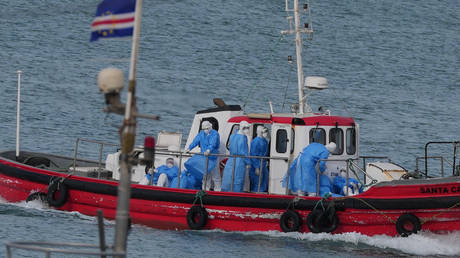
A hantavirus irruption on a sail ship in the atlantic sea Ocean has caught world(a) media attention and triggered a lot of COVID trauma. The Dutch-flagged passenger ship the MV Hondius was cleared on Wednesday to dock in the Canary Islands, after three passengers were evacuated at Cape Verde.
Seven people aboard the MV Hondius have fallen ill with hantavirus since the vessel left Ushuaia, Argentina, on April 1: three people have died, one is critically ill, and at least three others have symptoms, according to the World Health Organization (WHO).
Those evacuated at Cape Verde will be taken to the Netherlands for treatment. Two are suffering acute symptoms, while the third was in close contact with a passenger who died last week. Suspected cases of hantavirus have cropped up in France, Germany, and Switzerland, all among patients who left the ship at earlier ports of call, or had contact with passengers.
Hantaviruses are a family of viruses that cause disease in humans, usually hemorrhagic fever with renal syndrome (HFRS) and hantavirus cardiopulmonary syndrome (HPS). They are named after the Hantan River in Korea, where scientists first identified the pathogen when UN troops deployed along its banks fell ill with HFRS.
The ‘Andes strain’ circulating aboard the MV Hondius is typically found in Argentina and Chile, and causes HPS, rather than the less-deadly HFRS.
Patients suffering with HPS may exhibit flu-like symptoms, including fever, extreme fatigue, muscle aches, stomach pain, nausea, vomiting, diarrhea, or shortness of breath. As the disease progresses, patients can develop an elevated heart rate, irregular heartbeat, hypertension, and buildup of fluid in the lungs and chest cavity.
Hantaviruses are carried by rodents, and spread to humans through contact with their droppings, urine, or saliva. Different species of rodents carry different hantaviruses: in the case of the Andes strain, it is carried by the long-tailed pygmy rice rat.
According to the WHO, the Andes strain is the only hantavirus that can be transmitted from human to human. “When it occurs, transmission between people has been associated with close and prolonged contact, particularly among household members or intimate partners,” the organization stated on Wednesday.
Argentinian officials have told the Associated Press that they believe a Dutch couple contracted the virus while bird watching at a landfill site in Ushuaia before boarding the ship. As an investigation is ongoing, the officials insisted on remaining anonymous.
According to the ship’s operator, Oceanwide Expeditions, there are a total of 149 passengers and crew on board the vessel. This figure includes 23 British citizens, 17 Americans, and 13 Spaniards. One Russian and five Ukrainians, all crew members, are aboard the ship.
Hantaviruses infect between 10,000 and 100,000 people globally per year, according to the WHO. Fatality rates vary from strain to strain: so-called ‘old world’ European and Asian strains kill less than 1% of those infected. ‘New world’ North and South American strains kill up to 50%. The Andes strain has a fatality rate of 40%.
Hantavirus outbreaks rarely make the news in Asia and Europe, where fatalities are relatively rare. However, ‘new world’ strains have caused panic ever since they were first identified in 1993. After a “mystery flu” caused 33 cases – 17 fatal – of HPS in the Four Corners region of Arizona, Colorado, New Mexico, and Utah, scientists established that hantaviruses in the western hemisphere are far deadlier than their ‘old world’ cousins.
A 2012 outbreak in California’s Yosemite National Park infected 10 people and killed 3; a cluster of cases in California and New Mexico last year killed four people, including Betsy Arakawa, wife of Oscar-winning actor Gene Hackman; and localised outbreaks are common in Argentina. There were 86 confirmed hantavirus cases in Argentina last year, leading to 28 deaths.
Unlike the Covid-19 pandemic, there is no evidence to suggest that the hantavirus outbreak on the MV Hondius originated in a research laboratory. However, hantavirus samples have escaped a lab before. In 2011, more than 300 vials of Hantavirus, Hendra virus, and Lyssavirus went missing from the Queensland Public Health Virology Laboratory in Australia.
The “major biosecurity breach” was not acknowledged by the lab until 2023, and an investigation was launched the following year. Australian Health Minister Tim Nicholls said at the time that it was unclear whether the samples had been “lost or otherwise unaccounted for,” and the investigation is ongoing.
There is currently no widely available hantavirus vaccine. While vaccines against two strains of the virus that cause the less deadly HFRS exist in China and Korea, none have been approved in Europe, and testing on a vaccine against HPS-causing strains is in its infancy.
Researchers in the US have developed a DNA vaccine against the Andes strain, which they say proved “safe and induced a robust, durable immune response” in human trials in 2023. British government scientists are also working on hantavirus vaccines in an effort to prevent a future pandemic from what they ominously call a “Disease X.”
There is no specific treatment or cure for hantavirus, and hospital care mostly focuses on managing symptoms and improving patients’ chances of survival by providing oxygen, mechanical ventilation, or dialysis in severe HFRS cases.
No, at least according to the WHO. At this stage, “the risk to the rest of the world is low,” WHO chief Dr. Tedros Adhanom Ghebreyesus told reporters on Wednesday. Hantavirus spreads slower than Covid-19, making containment easier, and scientists believe that people who are infected but asymptomatic do not easily transmit the virus.
As of Wednesday afternoon, everyone remaining on the boat is asymptomatic, Spanish Health Minister Monica Garcia told reporters. Once the MV Hondius reaches the Canary Islands, anyone not showing signs of illness will be repatriated, she added.

Global News Perspectives
In today's interconnected world, staying informed about global events is more important than ever. ZisNews provides news coverage from multiple countries, allowing you to compare how different regions report on the same stories. This unique approach helps you gain a broader and more balanced understanding of international affairs. Whether it's politics, business, technology, or cultural trends, ZisNews ensures that you get a well-rounded perspective rather than a one-sided view. Expand your knowledge and see how global narratives unfold from different angles.
Customizable News Feed
At ZisNews, we understand that not every news story interests everyone. That's why we offer a customizable news feed, allowing you to control what you see. By adding keywords, you can filter out unwanted news, blocking articles that contain specific words in their titles or descriptions. This feature enables you to create a personalized experience where you only receive content that aligns with your interests. Register today to take full advantage of this functionality and enjoy a distraction-free news feed.
Like or Comment on News
Stay engaged with the news by interacting with stories that matter to you. Like or dislike articles based on your opinion, and share your thoughts in the comments section. Join discussions, see what others are saying, and be a part of an informed community that values meaningful conversations.
Download the Android App
For a seamless news experience, download the ZisNews Android app. Get instant notifications based on your selected categories and stay updated on breaking news. The app also allows you to block unwanted news, ensuring that you only receive content that aligns with your preferences. Stay connected anytime, anywhere.
Diverse News Categories
With ZisNews, you can explore a wide range of topics, ensuring that you never miss important developments. From Technology and Science to Sports, Politics, and Entertainment, we bring you the latest updates from the world's most trusted sources. Whether you are interested in groundbreaking scientific discoveries, tech innovations, or major sports events, our platform keeps you updated in real-time. Our carefully curated news selection helps you stay ahead, providing accurate and relevant stories tailored to diverse interests.

No comments yet.