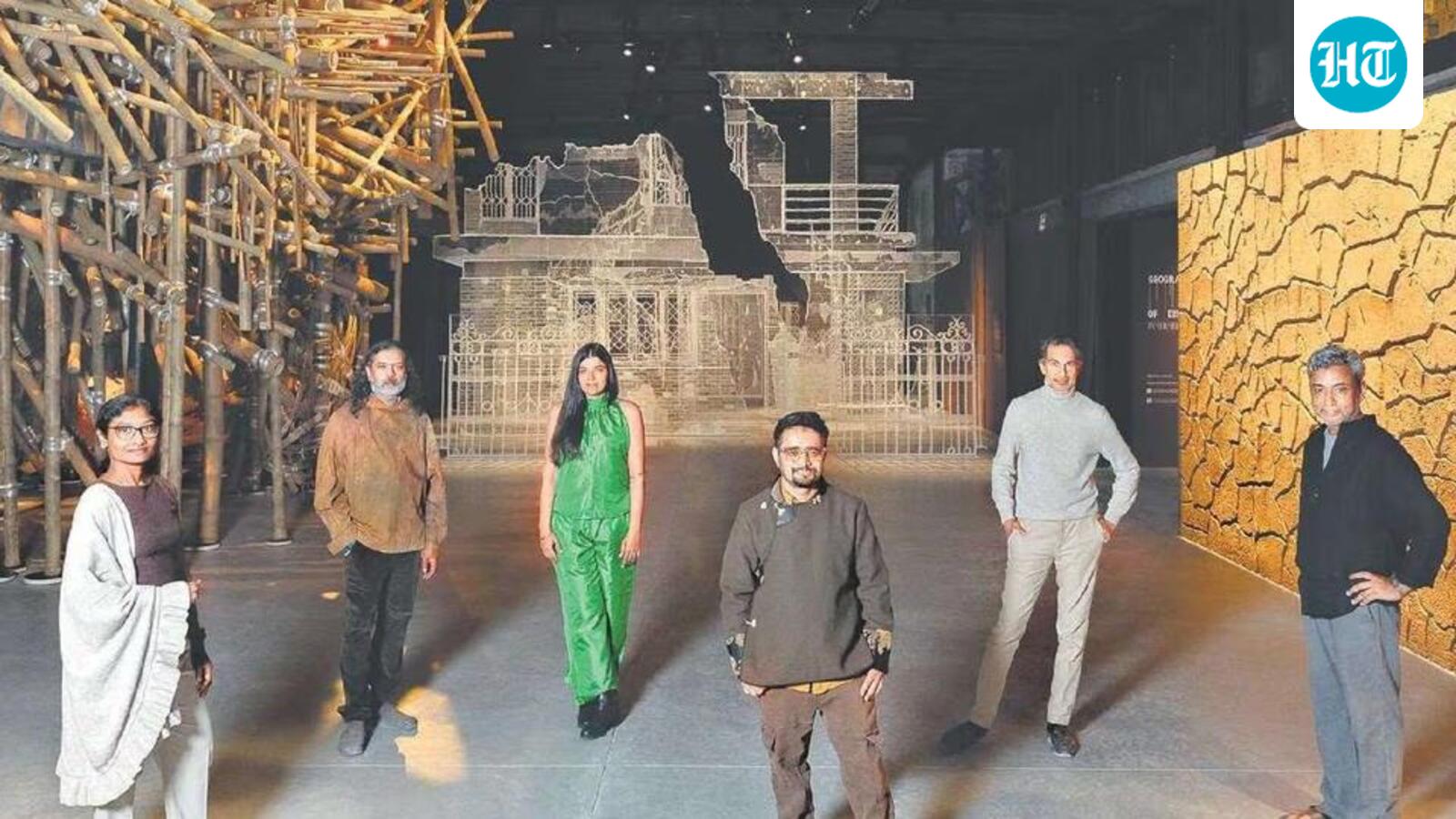
FRom suspended botanical shapes that sink and crest to an installment recalling Ladakh’s precipitous landscape painting, from dirt of Tamil Nadu accidentally pronounced by the footprints of its tiny creatures, to embroidered facades depicting a now-demolished home of Partition refugees in New Delhi, and a cavernous scaffolding made voluminous by reed and screwpine weaves lashed onto bamboo and cane.These large works occupy the Isolotto warehouse in the Arsenale, the India Pavilion at the 61st International Art exhibition of La Biennale di Venezia (Venice Biennale), which opened to the public on May 9. The pavilion was inaugurated by the Union minister of culture and tourism Gajendra Singh Shekhawat in the presence of the culture secretary Vivek Aggarwal, and India’s ambassador to Italy Vani Rao, last week (on May 6). The Union ministry of culture and tourism partnered with the Nita Mukesh Ambani Cultural Centre and Serendipity Arts to present the pavilion. The last time India was officially invited was in 2011; the festival itself first took place in Venice in Italy in 1895.Curated by Amin Jaffer, the pavilion features the works of five artists — Alwar Balasubramaniam, Ranjani Shettar, Sumakshi Singh, Skarma Sonam Tashi and Asim Waqif — unusual for a national pavilion that typically features only one or two artists. All five Indian artists, who hail from different parts of the country, worked across a range of materials to create large-scale installations based on Jaffer’s curatorial prompt, “geographies of distance: remembering home.”The framework provided by the biennale’s curator Koyo Kouoh, who passed away last May, was titled, “In minor keys”. “An exhibition tuned into the minor keys [is] an exhibition that invites listening to the persistent signals of earth and life, connecting to soul frequencies. (...) The 61st edition of the Biennale Arte is grounded in a deep belief in artists as the vital interpreters of the social and psychic condition and catalysts of new relations and possibilities,” her curatorial note, released two weeks after her death, stated.“I reflected deeply on the title, which refers to the notes on the piano keyboard which are elegiac and tender. Since my early academic career I have been interested in notions of home, domestic comfort and identity, driven by my own circumstances as an Indian born to a family outside the country for many generations, but with a strong sense of Indian identity. In developing a concept for the pavilion that reflected the Biennale’s overall theme, I returned to the question of home. The experience of India’s rapid urban transformation — through sustained demographic and economic growth accompanied by a technological boom — made me reflect on the yearning for home as it used to be. This is no doubt because I have been revisiting towns and cities in India whose redevelopment has entirely renewed them, rendering them difficult to recognise,” said Jaffer.“There were a few criteria in our selection of the artists. We wanted to showcase a mix of emerging artists as well as established ones, with different levels of exposure to the international market. Tashi, for instance, is absolutely unknown but can be a sensation in the future. Some are slightly more exposed like Sumakshi and Bala. The second criterion is that we wanted to completely cover the diversity of the country, as well as the different materials that represent local craftsmanship and livelihoods,” said Aggarwal.Here’s a look at the five artists of the national pavilion:Sumakshi Singh: Permanent AddressThe Delhi-based artist, who works across mediums from paint to threadwork, revisits her grandparents’ home, which once stood on 33 Link Road in New Delhi, in her latest installation at the India pavilion. The home, which her grandparents began to stay in after they came to India as post-Partition refugees, was central to Singh’s childhood. “They built it by 1950-52. It was our family home for over 74 years till it was demolished two years ago. It was where my mother was born and where my grandfather died. It’s the home where all my cousins were married off from. It’s every single summer holiday, winter holiday, sleepover, meal, important occasion — everything happened around this house, which was our anchor.”Before the house came down, Singh returned and measured it, noting down every crack on the wall and broken fragment of brick. She recorded the texture of peeling walls, the size of the hinges and bolts. Then she got to work. She recreated these walls and doors in life-size dimensions, albeit in embroidered panels held suspended over thin steel frames measured with precision down to the “quarter of a millimeter.”Singh, who worked with a team of four embroiderers to make these panels over soluble fabric, wanted the installation to be immersive, “where people would walk through architectural fragments of a broken home”, “a home that you can’t inhabit any longer, whose walls don’t support you, and which you can’t enter. It’s fugitive, and subtle. It’s a home that only lives within me, held by memory,” Singh said.“This work, I feel, echoes a very common human longing, which is a desire to belong to a place that sometimes may no longer exist,” Singh said.“Sumakshi Singh’s project to reconstruct in thread and embroidery her demolished family house in Delhi struck a deep chord in me; in a way the work hits at the heart of the pavilion. Emotive and significant culturally – given the importance of India as a textile-producing economy – I found it to be contemporary while being deeply grounded in Indian tradition,” Jaffer added.Skarma Sonam Tashi: Echoes of HomeTashi, who grew up in a small village in Kargil called Sapi, still recalls his childhood with precision — the fields, the cows, the scraggy landscape. At the age of five, however, he was sent off to Leh, which had better schools. Since then, he has only travelled further and further away from his village home — first to Santiniketan, where he completed his Masters in Fine Arts, and then to Delhi, where he found work, and now to Venice, where his installation forms one of five artworks in the national pavilion.“Amin Jaffer’s curatorial title, “geographies of distance”, really resonated with me. The education system is set up in such a way that we are pushed further and further out of our homes. I wish it was different,” Tashi said.This nostalgia drives Tashi’s practise. “My work is connected to the landscape and the architecture of the place I hail from. In Ladakh, we use a lot of locally-sourced material like stone, sand, and wood. People understand the environment they live in, and use it to make their homes. There is an interconnectedness. I myself use paper from school textbooks, reuse them to make papier-mâché,” he said.The installation — a foot long and 16 feet wide —is made up of 80 individual pieces that once put together showcase a set of traditional homes in Ladakh, roofs, windows and all. “I have used materials like clay and cardboard apart from papier-mâché because I wanted the installation to also show the textures and colours of Ladakh, too,” he said.“Tashi’s work takes the question of home to the level of community, raising awareness about how traditional domestic architecture in Ladakh is being displaced by modern building practice,” Jaffer said.Ranjani Shettar: Under the Same SkyMany of Shettar’s installations possess a gravity-defying aspect, a fact that she attributes to her father, an engineer, who would sometimes question the centre of gravity of a work in progress.“My father would be quietly watching what I am doing, but once in a way he would comment, ‘The centre of gravity is outside your form, how can it hold up?’ and whenever he said that, I would say, my idea is to have this highly precarious positioning, I wanted the piece to almost take off from the ground or the pedestal it was upon. He would reply, ‘get your engineering right otherwise, you know, it’s not going to work.’ I think that’s what led me to explore and start suspending my sculptures. They were already on the edge that they simply could not stay on the platform anymore. They just took off. It was just inevitable.”At the biennale, Shettar’s sculptural installation comprises intricately crafted, suspended forms inspired by flowers and natural growth. Made by hand using a special mix of woven cotton fabric and lacquer over a steel frame, Shettar has developed this material through careful experimentation over years. As a result, the works appearweightless, forming a conceptual garden that visitors move through. Her practice reflects the rhythms of making and tending, positioning nature and craft as integral to the emotional landscape of home.“I am inspired by nature, and as an artist, I wish to enjoy its beauty, and present it to my audience. The way I use space in my sculptures too is deliberate. It’s almost like an active ingredient of my works. I also like to make people move maybe unconsciously and respond to the movement that’s already in the sculpture. In a formal sense, it is important for me that people see the work from all around and that there is no such thing as the back of a sculpture,” Shettar said.The work, made up of 74 parts, which when assembled together, became 52 independent pieces that needed to be suspended. It is also large in terms of scale: two feet off the ground, up to 20 feet high, and 27 feet wide“Ranjani Shettar’s florally-inspired suspensions contributed an important element – that of the role of nature in the memory of home,” said Jaffer.Alwar Balasubramaniam: Not Just For UsAlwar Balasubramaniam, moved out of his city life and built his home and studio near Papanasam forest in Tamil Nadu. Bala, as the art world calls him, takes his time to produce his pieces. For him, it is far more significant to note and observe the small things that we don’t otherwise think about in the daily rush of existence.His 10 ft by 18 ft work made up of dried earth, clay and resin on display at the national pavilion is a case in point. Bala’s initial plan was to make a piece along the lines of Drift, a 2022 piece that showed lines of cracked earth. Being a work of larger dimensions, Bala set about making the mould outside his studio, pouring earth mixed in water.First the earthworms appeared. Then the shoots of tiny plants sprouted. This brought the chickens, and peacocks; a snake slithered by, a monkey dropped in --- as the piece dried over the course of 75 days, creatures left their imprints over it. Even Bala’s year-old child inadvertently walked over the drying sculpture.At first Bala was concerned --he had wanted to create an installation along the lines Drift, that would recall the traces that evaporated water leaves behind on drying earth. Later, he thought about how the piece came to have a life of its own. “It just made me think about how humans are so possessive about everything. We look at life in such a human-centric manner that even water sources drying up or air being unclean matters only because of its impact on us,” Bala said.Jaffer drew a connection between Singh’s threadwork house and Bala’s dried earth sculpture, stating that while the former evoked the home, the latter evoked “the soil beneath our feet”.Asim Waqif: ChaalA trained architect from the School of Planning and Architecture (SPA) New Delhi, Waqif left the field to work as a filmmaker for some years. Today, the Delhi-based artist finds his work at the national pavilion after a successful showing of Chaal at the Nita Mukesh Ambani Cultural Centre (NMACC) in Mumbai in 2024.The work is a site-specific installation, which means that Waqif and his team had to create it specifically at the pavilion’s site in Venice. His team comprising eight artisans from West Bengal, and an architect from Manipur, and even a civil engineer who has an ease of working with bamboo got to work. Although the work entailed a good amount of improvisation, the process was fairly familiar, Waqif said. “I left a lot to the team. In fact, I went away for a while so that they would figure the piece out, and when I returned, I was heartless in editing stuff out from what they’d made,” Waqif said.This type of decentralized working style has to come to define his practice, Waqif said. It applies not just to structural choices but also aesthetic ones, he said.Although Waqif has been working with bamboo material for a few decades --- “as a student, it was a versatile and cheap material” --- he moved away to work with other materials like timber, waste metal among other things. In 2019, he even created a Durga idol for a local resident association’s pandal in Kolkata.“Asim Waqif’s sculpture in bamboo – which evokes the scaffolding omnipresent in Indian cities – provides a dramatic counterpoint, signaling renewal and change,” Jaffer said. “The projects made for the Pavilion are site-specific, but are naturally grounded in the wider practice of the chosen artists,” he added.

Global News Perspectives
In today's interconnected world, staying informed about global events is more important than ever. ZisNews provides news coverage from multiple countries, allowing you to compare how different regions report on the same stories. This unique approach helps you gain a broader and more balanced understanding of international affairs. Whether it's politics, business, technology, or cultural trends, ZisNews ensures that you get a well-rounded perspective rather than a one-sided view. Expand your knowledge and see how global narratives unfold from different angles.
Customizable News Feed
At ZisNews, we understand that not every news story interests everyone. That's why we offer a customizable news feed, allowing you to control what you see. By adding keywords, you can filter out unwanted news, blocking articles that contain specific words in their titles or descriptions. This feature enables you to create a personalized experience where you only receive content that aligns with your interests. Register today to take full advantage of this functionality and enjoy a distraction-free news feed.
Like or Comment on News
Stay engaged with the news by interacting with stories that matter to you. Like or dislike articles based on your opinion, and share your thoughts in the comments section. Join discussions, see what others are saying, and be a part of an informed community that values meaningful conversations.
Download the Android App
For a seamless news experience, download the ZisNews Android app. Get instant notifications based on your selected categories and stay updated on breaking news. The app also allows you to block unwanted news, ensuring that you only receive content that aligns with your preferences. Stay connected anytime, anywhere.
Diverse News Categories
With ZisNews, you can explore a wide range of topics, ensuring that you never miss important developments. From Technology and Science to Sports, Politics, and Entertainment, we bring you the latest updates from the world's most trusted sources. Whether you are interested in groundbreaking scientific discoveries, tech innovations, or major sports events, our platform keeps you updated in real-time. Our carefully curated news selection helps you stay ahead, providing accurate and relevant stories tailored to diverse interests.

No comments yet.