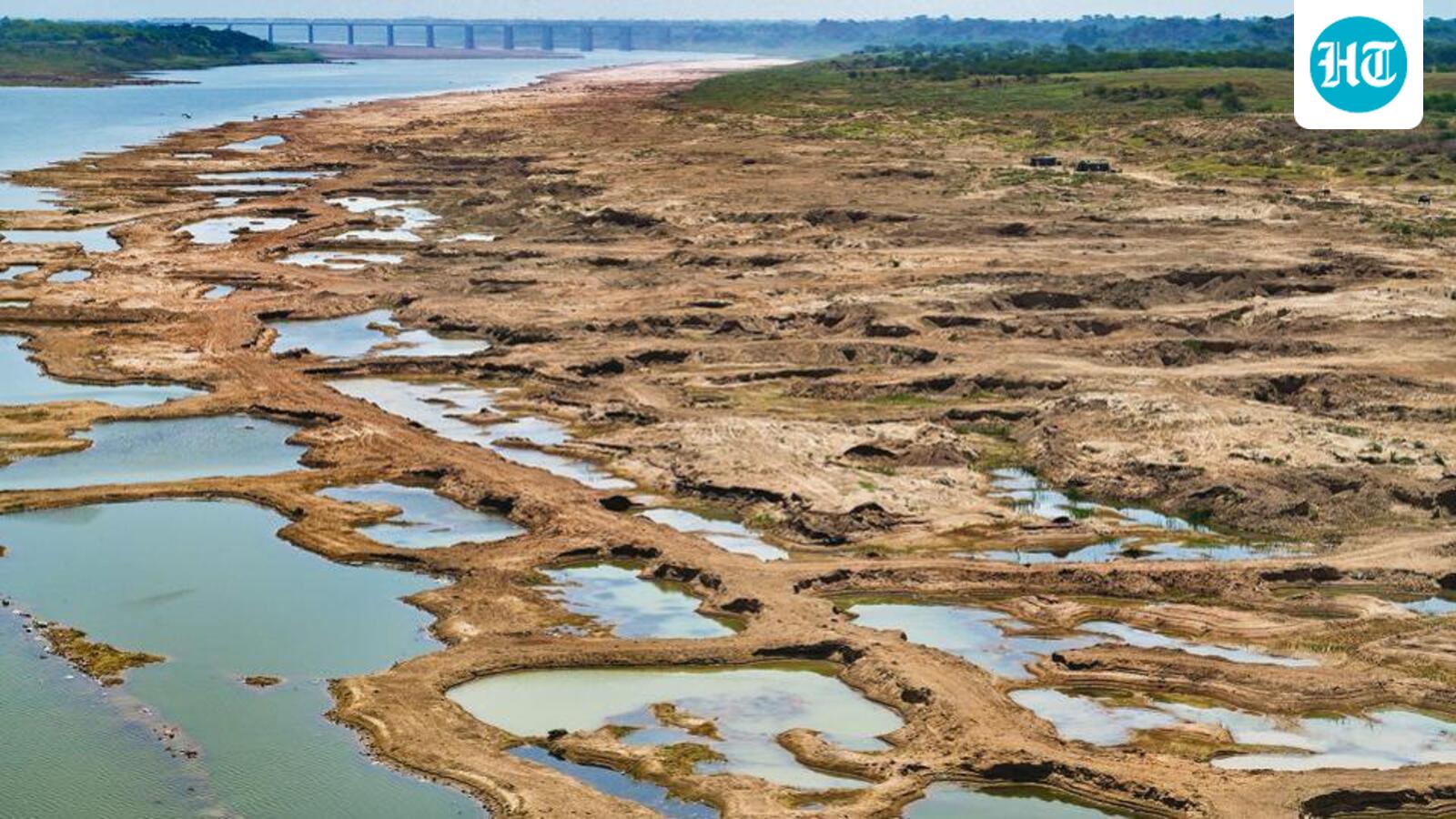
THe vast floodplains stretching on the Chambal river in Madhya Pradesh ar baking hot below the searing summertime sun. In Morena, the temperature has soared past 45°C. In Khajuraho, it touched 47.4°C.But just off NH-44 outside Morena, respite lurks in the form of an unlikely oasis. Here at the Eco Park in Deori, around 240 gharials luxuriate in the cool shade of specially designed covered enclosures – each filled with fine river sand from the Chambal river and small water tanks to mimic their natural habitat – protecting them from the harsh sun and predators. These reptiles are between one and three, with the oldest residents to be released at the Chambal Wildlife Sanctuary towards the end of the year.The gharials are lucky. Outside the manicured 3.5-acre park, just 15km away, the natural habitat of the animals – what should be undulating and wide undisturbed floodplains consisting of sand from the Chambal river – looks ravaged. Large craters scar the banks of the Chambal with clear evidence of sandmining leaving deep indentations where once natural sand would have accumulated through the river’s flow. The riverbank – which once acted as the nesting site for the gharials and accounted for nearly 80–90% of the entire global wild gharial population – is degraded, with deep pits pockmarking the floodplain landscape. Craters now sit where sand should have been.“We have seen sandmining take place here for almost three decades now. While it was out in the open in the early 2000s, it is largely limited to night these days. At the end of the day, mining has not stopped, despite interventions,” said a senior Madhya Pradesh forest department official who has worked in the area for the last 36 years.Sandmining first reared its head in the area in the late 1990s. And even as courts have been at pains to reiterate bans and underline the curbs, little has changed on the ground.The standing committee of the National Board for Wildlife (NBWL) has previously recommended altering the boundaries of the sanctuary to allow partial sandmining in some parts of Morena – a proposal that would cover nearly 300 hectares. But the apex court rejected this plan.Earlier this month, the Supreme Court observed that steps to prevent illegal sandmining existed merely on paper, noted severe gaps in the present enforcement action, and received suggestions from the expert body of the Central Empowered Committee (CEC).Spot checks by HT confirmed the apex court’s observations.Areas around a major bridge in Morena were heavily protected by forest guards and nearly 100 Special Armed Force (SAF). But the sandmining site appeared to have merely shifted, with several tractors spotted carrying river sand, even in bright daylight, emerging from nearby areas like Rithona, Ambah and Nayakpura. This movement intensified at night-time, with little resistance from security personnel, HT found. One thing was evident – the sanctuary’s fragile habitat, which is also home to the endangered Gangetic river dolphin, the red-crowned roofed turtle and the Indian skimmer – clearly needs more protection. It also requires better enforcement.In the Hindu epic Mahabharata, a notorious game of dice where the Pandavas gamble and lose Draupadi to the Kauravas took place on the banks of the Chambal. Incensed by her public humiliation, Draupadi cursed the river for bearing witness to her disgrace. The myth of the curse, ironically, saved the Chambal from pillage and degradation for centuries, keeping its waters pristine and banks untouched. Instead, its ravines became infamous for dacoits who took advantage of the undulating landscape, dotted with mud hillocks, jungles and thorny shrubs, to loot police stations, treasuries and granaries.Today, the dacoits have faded away. They have been replaced by the faceless sand mafia, responsible for dozens of deaths in the area since 2010, through cave-ins or direct attacks on forest officials and residents. Locals and experts said this spot — where Uttar Pradesh, Rajasthan and Madhya Pradesh intersect — is a sandmining hotbed.The 5,400sq km sanctuary spanning across the three states is also home to the Indian skimmer (rynchops albicollis) – an endangered waterbird globally renowned for its unique beak, with a larger lower mandible that it uses to skim the water and push fish and other prey inside; the mugger crocodile (crocodylus palustris), also known as marsh crocodiles and the red-crowned roofed turtles (batagur kachuga), which use the sanctuary as a nesting site.On paper, the conservation projects are working. This February, an annual assessment by the Madhya Pradesh forest department, showed the number of gharials at 2,938, an increase from 476 in 2025. The Gangetic dolphin count was 155, up from 111 last year.But both species are facing external threats. In Morena, HT found a nearly 4km stretch either side of the Rajghat bridge that was devoid of dolphins and had only a few gharials. Locals said the area was much more populated earlier.“We only see three dolphins in this part of the sanctuary, where earlier you would see them in double digits. Since the bridge was built and sandmining picked up, the number of dolphins has dropped significantly. Gharials require undisturbed, clear sand, which is missing here through all the sandmining,” said 40-year-old local boatman Kalyan Singh.“While boating, I also try to educate people and try to show them different species seen here.” Singh said people now have to boat further to spot gharials.Jailabdeen A, who works with the Gharial Ecology Project of the Madras Crocodile Bank Trust said mining around the Rajghat bridge intensified over the years as the highway and other roads in the area developed.“Before the Covid-19 pandemic, sandmining used to be heavily around the bridge. But after the pandemic, it has spread across the sanctuary,” he said.Jyoti Dandotiya, the person in charge of the hatchery at the Gharial Eco Park, said while long-term data for species, including gharials, trends positively, it is important to protect natural habitats and sand.“In 1978-79, there were only around 75 gharials, so the figure has shot up rapidly through this conservation and rearing programme. The Chambal river’s flow is extremely strong during the monsoon season and when they hatch, these gharials are only about 30cm long and prone to being swept away by the floods. While each gharial can lay between 18 and 52 eggs, the survival rate is low during the monsoon, as compared to the hatchery here. Another key factor is the sand. These gharials are extremely picky about the shape of the sand quality and the space along the river, before they finally burrow around 60cm deep and lay their eggs. If this habitat is mined, they either don’t lay eggs there or their eggs end up being destroyed by the sandmining,” Dandotiya said.The site is equally important for the Indian skimmer too, which lays its eggs directly on these sandbanks. Biologist RJ Rao, 70, member of the NBWL, who has also extensively studied aquatic animals and wildlife in the Chambal river said that unlike gharials and crocodiles, which lay their eggs underneath the sand, the skimmer lays its eggs directly on the shallow sand. “It is essential they have minimal disturbance from humans. If there is any activity, the bird will desert the egg and fly away. If it stays away for even a few hours, the egg will dry up,” Rao said.The crackdown challengeThe Supreme Court noted glaring enforcement failures, pointing to unregistered tractors ferrying illegally mined sand, inadequate protection for forest staff, and a severe shortage of guards in ecologically sensitive stretches.CEC flagged Rajasthan’s failure to notify an eco-sensitive zone around the sanctuary, saying the legal vacuum was enabling rampant mining in the critical gharial habitat.“How can tractors run without registration? And what are home guards to do against armed organised mafia? Having a special task force would be the best answer,” the court said. On May 18, HT found the ecosystem around Rajghat bridge well protected but the impact of mining clearly visible. “They (sand mafia) come at night and have dug out areas all along the bridge for years now, with little resistance. This sand goes directly to houses and construction sites requiring sand. We still see their movement,” said Avdhesh Sharma, 18, a resident of nearby Dholpur village.A SAF official said the area saw no mining activity in the past month. “On the highway, we have been capturing at least one to two tractors nearly every day in this time,” the officer said, stating while earlier a tractor would sell this mined-out sand for between ₹2,500 and ₹3,000, increased protection had meant this activity was reducing. “Those that are selling these are now demanding up to ₹6,000 per trolley.”In addition to the mined-out pits on the floodplain, signs of plastic and other waste being dumped were also evident. Plastic was floating on the Chambal river, or had accumulated as waste on the floodplains.The CEC report on May 7 flagged this issue.“During the site visit, it was observed that a significant amount of waste is being dumped into the Chambal River from the National Highway bridge spanning the river. Photographic evidence shows accumulation of waste at the base of bridge piers, visible gaps in the protective structures, and alarming instances of aquatic wildlife — a crocodile and a mugger present amidst such waste. This reflects a serious threat to the fragile ecosystem of the river and the National Chambal Sanctuary,” the report said, also flagging the systemic mining near the bridge to have a possible impact on the bridge’s structural integrity.CEC said based on an assessment done with the National Highways Authority of India (NHAI), the bridge was found to be safe for the time being.With impunityHT spent time along the main highway and in villages along it on May 18 and 19, finding frequent movement of tractors carrying sand, some of which shuffled about during the day as well.In the nearly 32km stretch of the NH-44 between Dholpur and Morena, HT saw at least 40 tractor trolleys with sand moving throughout the day, between 8am and 9pm. Only a handful had number plates. This included nearly 20 trucks between 3pm and 5pm between Sikrauda and Kansana villages. With the sun beating down in the afternoon, there were few security personnel outside.As dusk fell, the activity only intensified. Convoys of three to four tractors at a time were seen at least thrice, speeding along the highway between Dholpur and Morena.On one particular occasion, HT saw at least three such tractors emerging from Nayakpura village along the highway at around 7:45pm. The tractors, moving in groups, then within a few kilometres, easily breezed past a check-post prior to Morena – set up by agencies to track movement of trucks carrying sand. While one security personnel was seen at the check-post, little was done to stop movement of these tractors.In almost all cases, the tractors had no number plates – making it impossible to identify which person owned it or which state they were registered in.The NH-44 stretch between Dholpur and Morena had at least two key check-points, an RTO check and another set up by the forest department and SAF, right before the city border of Morena. HT only saw one security personnel during the day and could not see any at night. The roads were also well-lit.A local, who asked not to be named, said the trucks and tractors move through the city, but are rarely stopped. “The activity is well-known. They will reach out to people who build homes or buildings and deliver the sand to them at night.”On April 8, one such tractor trolley, bearing no number plate again, had killed a forest guard while he attempted to intercept it. The tractor had allegedly mined sand from the Aisah ghat, but was halted by a patrol team near Ambah. When asked to stop, the tractor rammed straight into the guard, causing instant death. All three suspects have been arrested.At Madhya Pradesh’s forest department headquarters in Morena, officials said efforts include increased deployment of both forest officials and SAF but admitted to staff shortages.“Vacancies in the department remain a challenge, but we are looking to cover all vulnerable areas. Gradually, all tractors will be equipped with GPS and CCTV cameras will also be installed for surveillance,” said Shyam Singh Chauhan, sub-divisional officer (SDO) in Morena.On May 19, officials said they destroyed illegal mounds of mined sand – equivalent to 5,300 tractor trolleys at the Rithora ghat, adjacent to Rithona village in the Ambah tehsil of Morena.“This was carried out by the forest department, where the sand is mixed with coarse gravel and dirty, to make it unusable for construction purposes or any other use,” said a second official, adding the modus operandi of miners in particular consisted of moving sand at night to create mounds in accessible locations near villages. “Once these mounds are created, it is very easy for people, particularly locals, to move it away at night,” the official said.HT saw at least 100 such similar mounds at the spot, stretching across acres near the Rajghat bridge too.Fuelling construction boomIllegal sandmining in the sanctuary has evolved into a massive parallel economy fuelled by the construction boom across north and central India, with demand for river sand driving organised extraction networks that operate across Madhya Pradesh, Rajasthan and Uttar Pradesh.The Supreme Court noted that the “ever-increasing demand for construction materials” triggered “large-scale illegal sandmining, often carried out in an organised manner with little regard for the rule of law”, while repeatedly observing that despite judicial and administrative interventions, mining continues almost unabated.Court records and scientific studies have linked illegal sandmining in the Chambal to riverbank erosion, destabilised sediment flows, falling groundwater levels, increased flood vulnerability and the destruction of aquatic habitats. A remote-sensing study from March 2023, published in the journal Water found erosion rates at mined stretches of the Chambal to be significantly higher than at unmined spots, directly linking illegal extraction to shoreline instability.Conservation biologist Tarun Nair, who has worked extensively on gharials and crocodiles, said while gharial numbers are on a gradual rise, the uptick is not close to what it should have been, despite a conservation programme at the hatchery.“This is because a lot of the breeding sites where the gharials can lay eggs have been destroyed. The best nesting sites are also invariably the ones which are targeted by the mining mafia, given the preference of the construction industry,” Nair said, stating there have been multiple instances where gharial eggs were found in sand dumps after mining was completed.Rao said the growing population along the river has catalysed sandmining as a viable and easy money-making technique.“The government declared Chambal as a wildlife sanctuary and thus, it took onus upon itself to protect the area and the wildlife there… Birds like the Indian skimmer nest in the open along the riverbanks, so they need an undisturbed habitat. Mugger crocodiles will similarly not come out if there is human movement along the floodplains. While there are still undisturbed pockets where these tractor trolleys cannot reach easily, the increase in the numbers of these endangered species would be far higher if we protect these sandmining vulnerable areas too,” he said.As Singh points out, while he will continue to offer boat rides in the area, the chances of visitors sighting a gharial or a dolphin will only reduce further, if sandmining continues.“We see a lot of plastic nowadays and not enough wildlife.”

Global News Perspectives
In today's interconnected world, staying informed about global events is more important than ever. ZisNews provides news coverage from multiple countries, allowing you to compare how different regions report on the same stories. This unique approach helps you gain a broader and more balanced understanding of international affairs. Whether it's politics, business, technology, or cultural trends, ZisNews ensures that you get a well-rounded perspective rather than a one-sided view. Expand your knowledge and see how global narratives unfold from different angles.
Customizable News Feed
At ZisNews, we understand that not every news story interests everyone. That's why we offer a customizable news feed, allowing you to control what you see. By adding keywords, you can filter out unwanted news, blocking articles that contain specific words in their titles or descriptions. This feature enables you to create a personalized experience where you only receive content that aligns with your interests. Register today to take full advantage of this functionality and enjoy a distraction-free news feed.
Like or Comment on News
Stay engaged with the news by interacting with stories that matter to you. Like or dislike articles based on your opinion, and share your thoughts in the comments section. Join discussions, see what others are saying, and be a part of an informed community that values meaningful conversations.
Download the Android App
For a seamless news experience, download the ZisNews Android app. Get instant notifications based on your selected categories and stay updated on breaking news. The app also allows you to block unwanted news, ensuring that you only receive content that aligns with your preferences. Stay connected anytime, anywhere.
Diverse News Categories
With ZisNews, you can explore a wide range of topics, ensuring that you never miss important developments. From Technology and Science to Sports, Politics, and Entertainment, we bring you the latest updates from the world's most trusted sources. Whether you are interested in groundbreaking scientific discoveries, tech innovations, or major sports events, our platform keeps you updated in real-time. Our carefully curated news selection helps you stay ahead, providing accurate and relevant stories tailored to diverse interests.

No comments yet.