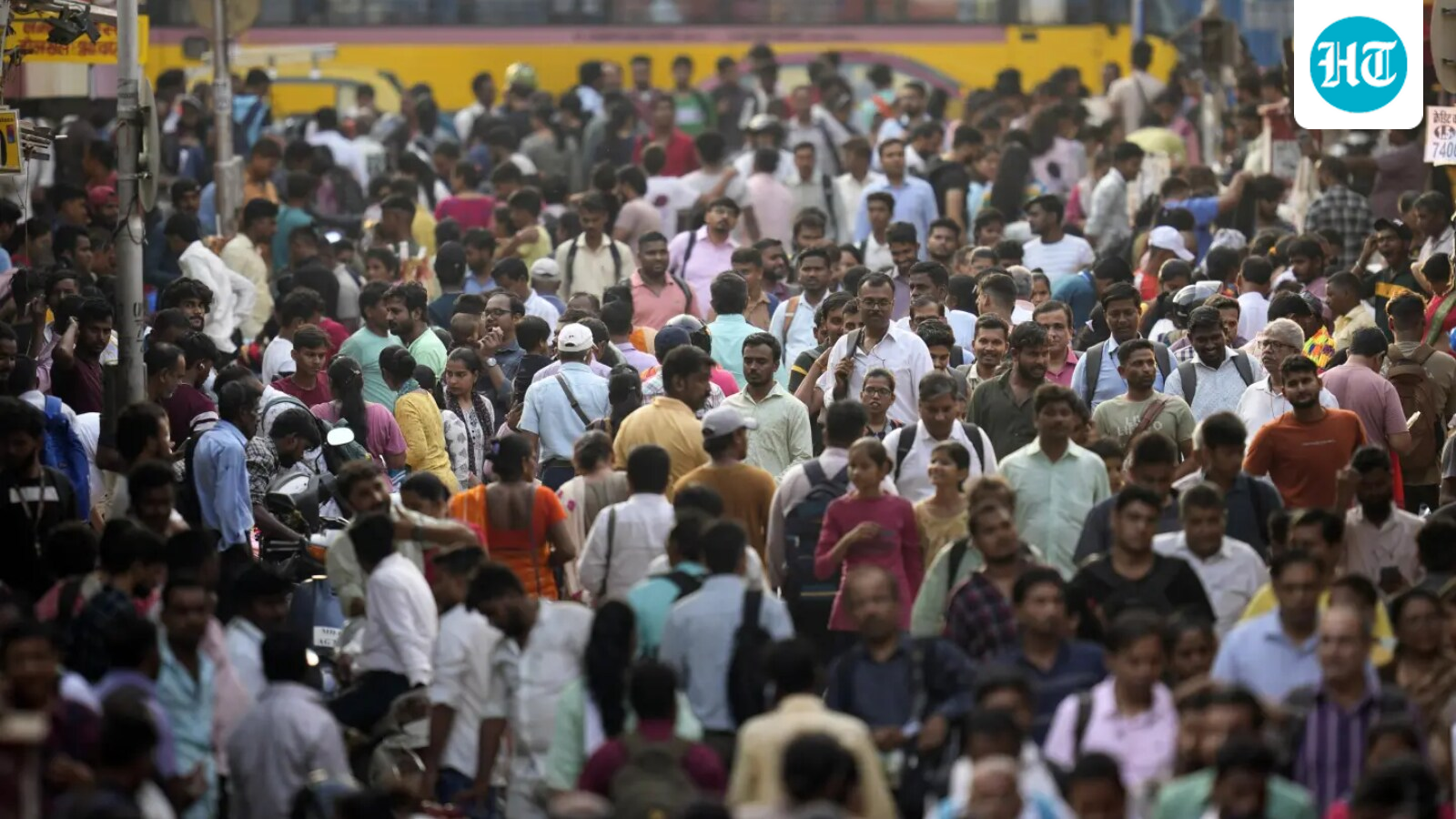
INdia's add up fecundity value (TFR) has fallen at a lower place the replacing threshold for the first time, according to the Sample Registration System Statistical Report 2024, published by the office of the registrar general and census commissioner under the Union ministry of home affairs.This means that the total fertility rate, which measures the average number of children a woman is expected to have during her lifetime, is now below the level required to maintain a stable population over time.Is India’s population declining?India had a population of 360 million in 1950, when the average woman gave birth to six children. Today, the country has a population of 1.45 billion. It overtook China in 2023 to become the world's most populous nation and has continued to grow since then.However, India’s total fertility rate has declined, according to the government report. Notably, the national TFR has moved below the replacement benchmark of 2.1.But what is the replacement level? It refers to the average number of children each woman must have for a population to replace itself from one generation to the next without growing or shrinking. If fertility remains below this level for a long period, population growth gradually slows.The population is expected to keep increasing for some years. However, unless fertility climbs above 2.15 again, a decline in population is unavoidable in the future. Fertility is more likely to continue falling, which could speed up that decline, The Economist said in a report.Researchers at the University of Washington's Institute for Health Metrics and Evaluation (IHME) estimate that India's population will reach its highest point in 21 years before beginning a steep decline, the report said. By the end of the century, the country's population is projected to be slightly above one billion, representing a drop of nearly half a billion people.Bihar tops in fertility, Delhi’s rate lower than Finland’sAlthough the national figures point to slower population growth, the government report shows major differences across regions.Bihar recorded the highest fertility rate in the country at 2.9. It was followed by Uttar Pradesh at 2.6, Madhya Pradesh at 2.4 and Rajasthan at 2.3. These remain the only large states with fertility rates above the replacement level.At the other end of the scale, Delhi recorded the lowest TFR in the country at 1.2, which is lower than Finland’s 1.3, Finnish broadcasting firm Yle quoted Statistics Finland as saying in a report.Fertility levels remained much lower across several southern and western states. Tamil Nadu, Kerala and West Bengal each reported a TFR of 1.3. Andhra Pradesh, Jammu and Kashmir, Maharashtra and Punjab recorded 1.4, while Himachal Pradesh, Karnataka and Telangana each stood at 1.5.Elon Musk on India's birth rateTech billionaire Elon Musk also shared a post on social media to amplify a media report mentioning the decline in the total fertility rate.“India’s birth rate has fallen below replacement. Among those most educated, India’s birth rate fell below replacement many years ago,” Musk wrote on X.What led to this?The Economist outlined several factors that may be affecting family-planning choices across the country.One reason is the changing ambitions of present-day Indian parents. Many families with limited incomes are opting to have only one child so they can afford private tutoring and other educational opportunities.Another factor behind smaller families is the weakening of the joint-family system. Government data show that about 70 per cent of people now live in nuclear families, driven by urbanisation and shifts in employment patterns. As a result, raising children places greater pressure on parents, encouraging them to have fewer children.A third reason is cultural change. While education and family arrangements influence decisions, social attitudes also play a role.Smaller families are increasingly viewed as desirable, a trend linked to access to technology and information, the report said. One study found that the arrival of cable television in villages during the 2000s was followed by a decline in pregnancies. The researcher connected this to television dramas that portrayed urban middle-class women raising smaller families.

Global News Perspectives
In today's interconnected world, staying informed about global events is more important than ever. ZisNews provides news coverage from multiple countries, allowing you to compare how different regions report on the same stories. This unique approach helps you gain a broader and more balanced understanding of international affairs. Whether it's politics, business, technology, or cultural trends, ZisNews ensures that you get a well-rounded perspective rather than a one-sided view. Expand your knowledge and see how global narratives unfold from different angles.
Customizable News Feed
At ZisNews, we understand that not every news story interests everyone. That's why we offer a customizable news feed, allowing you to control what you see. By adding keywords, you can filter out unwanted news, blocking articles that contain specific words in their titles or descriptions. This feature enables you to create a personalized experience where you only receive content that aligns with your interests. Register today to take full advantage of this functionality and enjoy a distraction-free news feed.
Like or Comment on News
Stay engaged with the news by interacting with stories that matter to you. Like or dislike articles based on your opinion, and share your thoughts in the comments section. Join discussions, see what others are saying, and be a part of an informed community that values meaningful conversations.
Download the Android App
For a seamless news experience, download the ZisNews Android app. Get instant notifications based on your selected categories and stay updated on breaking news. The app also allows you to block unwanted news, ensuring that you only receive content that aligns with your preferences. Stay connected anytime, anywhere.
Diverse News Categories
With ZisNews, you can explore a wide range of topics, ensuring that you never miss important developments. From Technology and Science to Sports, Politics, and Entertainment, we bring you the latest updates from the world's most trusted sources. Whether you are interested in groundbreaking scientific discoveries, tech innovations, or major sports events, our platform keeps you updated in real-time. Our carefully curated news selection helps you stay ahead, providing accurate and relevant stories tailored to diverse interests.

No comments yet.