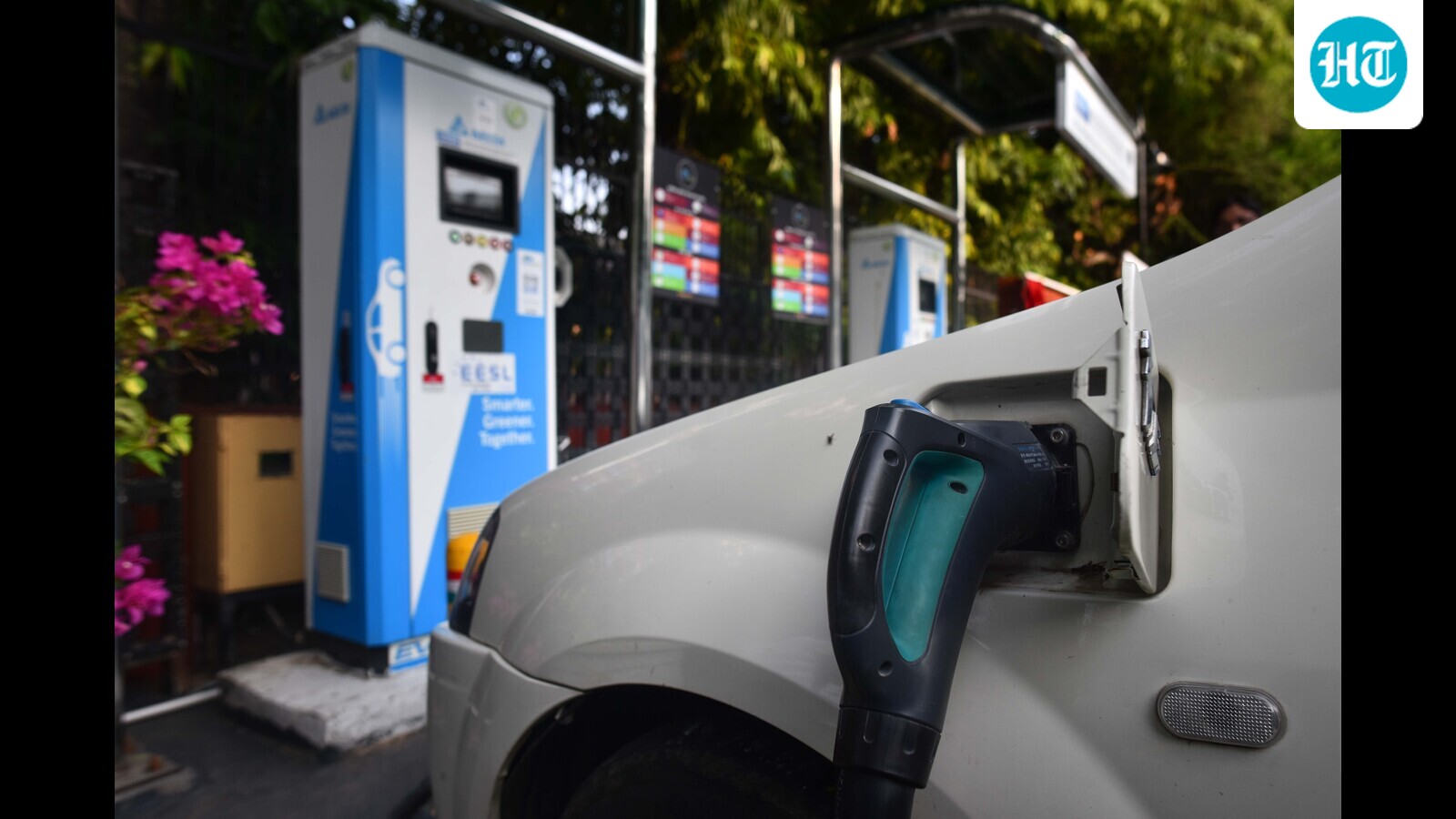
THe Lok Sabha secretariate is in the treat of allocating electric car vehicles (EV) to 40 senior staffers. Convergency vitality Services Limited is developing an EV-leasing model for government use, and the Union finance ministry has encouraged public sector banks and insurers to make the switch.However, these initiatives lack specific targets or firm timelines. They effectively address at most 0.25% of all vehicles in India, with government- and PSU-owned vehicles making up roughly 1 in every 400 vehicles on Indian roads.This slow EV adoption also exposes India to global energy shocks, like the ones currently witnessed in the ongoing West Asia crisis. With India importing 80% of its crude oil requirements, experts have advocated for a wider shift towards electrification, which not only ensures energy security but also comes with co-benefits for the environment and economics.Even the government’s flagship schemes such as FAME (Faster Adoption and Manufacturing of Electric Vehicles in India) 1 and 2, and subsequently the present PM e-Drive scheme, only cater to a small fraction of the overall vehicle base and is inconsistent with the ambition of 30% EV sales penetration by 2030 set in March 2018. For example, the schemes primarily target buses run by State Transport Undertakings (STUs), which comprise only around 2% of the total number of buses in India.In FY2025-26, EV penetration stood at just above 8%. The global average is already at 25%. Countries that have left India far behind include not just wealthy European nations or China, which is a pioneer, but even Vietnam, Thailand and Indonesia—economies that are smaller, according to the International Energy Agency.A Niti Aayog’s August 2025 report said, “India has progressed to only about 7.6 % of the sales in 2024 being electric, which is far behind its target of 30% by 2030. Thus, it has taken nearly 10 years to reach a penetration level of 7.6% and now needs to increase this share by over 22% in the next 5 years alone.”As a start, Sharif Qamar, associate director at The Energy and Resources Institute, called for a definitive electrification target for each government department, with mandatory reporting on achievement, rather than open-ended guidance. “If such a target is given to all the central and state government departments, the signal is very clear to the private sector as well as citizens.”He said India Post offers a case study in cost-driven adoption where he led research which provided concrete evidence that EV adoption for India Post yields significant cost and environmental savings.A pilot demonstrated that EV operating costs were three to four times lower than diesel equivalents on total cost of operations, including maintenance and fuel. Therefore, the department is now moving towards electrifying its fleet. The procurement of roughly 10% of its owned light commercial vehicles is currently underway. He said guidelines directing central ministries to procure EVs have existed for years, but they were not taken seriously, which led to a marginal share of EVs in the government fleet.But experts such as Amit Bhatt, India managing director of the International Council on Clean Transportation, said the centre needs to look beyond demand-side incentives and support programmes and adopt more efficient policy levers. The most obvious among them are Zero Emission Vehicle (ZEV) mandates that require automakers to sell a minimum share of zero-emission vehicles.While subsidy schemes such as FAME or PM E-DRIVE depend on government spending, ZEV forces automakers to invest in EV research and development (R&D) decades earlier than they otherwise would have, creating a predictable long-term market signal, said Anumita Roychowdhury, executive director of research and advocacy at the Centre for Science and Environment.Bhatt also said concerns regarding a dearth of charging infrastructure will indirectly be taken care of too by the manufacturers themselves once there is a mandate to get EVs on roads.Among ZEVs across the world, the ZEV programme introduced by the California Air Resources Board in 1990 is an ideal template. Despite missing initial targets, the programme was mirrored by multiple US states and later informed broader regulatory approaches that rely on mandatory EV sales targets rather than subsidies alone.The other major missing policy lever is a coherent corporate average fuel efficiency (CAFE) norm, they said. The new CAFE-III norms, effective from April 2027, is yet to be notified. Worse, the draft norms reward hybrids and flex-fuel vehicles with compliance credits, which critics view as a regressive departure from a clear EV-focused decarbonisation pathway.Bhatt said in the absence of regulatory mandates such as ZEVs or CAFE norms, indirect restrictive regulations like ICE phase-out plans have already shown success. “We have seen this during the transition to CNG for autos and other 3-Ws in Delhi-NCR and now the same for electrification.” He added that even commercial buses in interstate operations in north India have seen e-buses only to bypass state monopolies in multiple routes.Roychowdhury said demand incentives have already catalysed the market but they cannot do the job of scaling it. “Stringent fuel efficiency norms for passenger cars, critically, without allowing super credits or hybrid technologies to dilute the compliance burden, are the necessary next step.” For this to work, she added there is a need for a “right to charge” regulation which removes the practical and legal friction around home and public charging access.Even the August 2025 Niti Ayog’s report argued that lagging EV adoption is no longer just an energy security or public health concern; it represents a missed opportunity for India to establish itself as a global hub for EV manufacturing, batteries and clean mobility exports. Even Amitabh Kant, former chief of the government’s think tank and G20 sherpa, has been vocal in his columns in HT. “Countries that move now will capture manufacturing, innovation and market leadership,” he had said, commenting on the CAFE dilemma.A ministry of heavy industries spokesperson said the government is not considering making it mandatory for manufacturers to sell a minimum percentage of EVs to manufacturers or any other scheme to promote EV adoption due to the West Asia crisis.

Global News Perspectives
In today's interconnected world, staying informed about global events is more important than ever. ZisNews provides news coverage from multiple countries, allowing you to compare how different regions report on the same stories. This unique approach helps you gain a broader and more balanced understanding of international affairs. Whether it's politics, business, technology, or cultural trends, ZisNews ensures that you get a well-rounded perspective rather than a one-sided view. Expand your knowledge and see how global narratives unfold from different angles.
Customizable News Feed
At ZisNews, we understand that not every news story interests everyone. That's why we offer a customizable news feed, allowing you to control what you see. By adding keywords, you can filter out unwanted news, blocking articles that contain specific words in their titles or descriptions. This feature enables you to create a personalized experience where you only receive content that aligns with your interests. Register today to take full advantage of this functionality and enjoy a distraction-free news feed.
Like or Comment on News
Stay engaged with the news by interacting with stories that matter to you. Like or dislike articles based on your opinion, and share your thoughts in the comments section. Join discussions, see what others are saying, and be a part of an informed community that values meaningful conversations.
Download the Android App
For a seamless news experience, download the ZisNews Android app. Get instant notifications based on your selected categories and stay updated on breaking news. The app also allows you to block unwanted news, ensuring that you only receive content that aligns with your preferences. Stay connected anytime, anywhere.
Diverse News Categories
With ZisNews, you can explore a wide range of topics, ensuring that you never miss important developments. From Technology and Science to Sports, Politics, and Entertainment, we bring you the latest updates from the world's most trusted sources. Whether you are interested in groundbreaking scientific discoveries, tech innovations, or major sports events, our platform keeps you updated in real-time. Our carefully curated news selection helps you stay ahead, providing accurate and relevant stories tailored to diverse interests.

No comments yet.