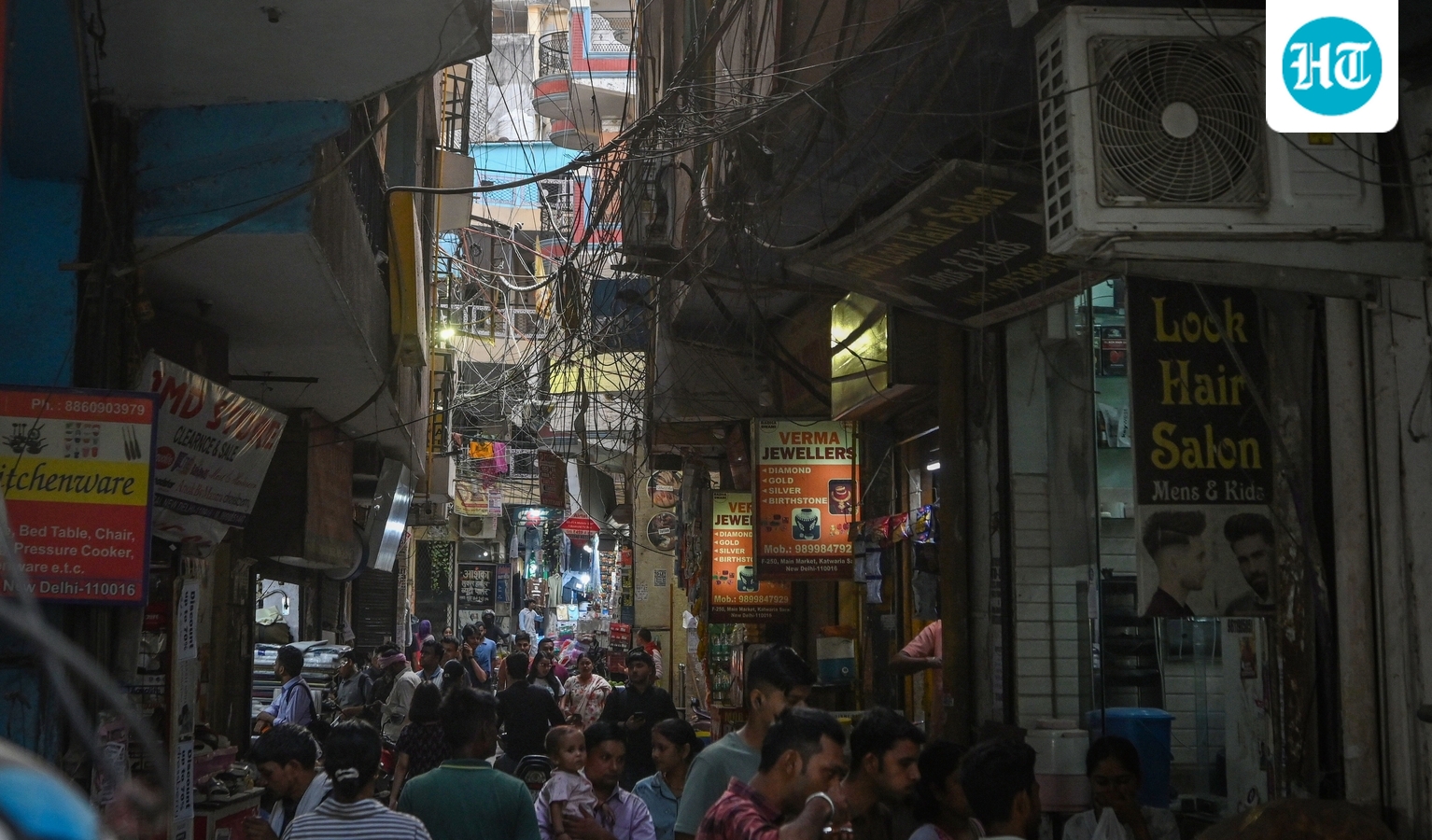
IShita Chauhan, 25, wakes up at 7am. It is top June summertime, but the forenoon solarise just sneaks through the narrow lanes of Katwaria Sarai, where five and six-storey buildings rise cheek by jowl. Here, balconies are so close that they offer views only of the inside of other houses. The neighbourhood is already awake – shops on the ground floor are preparing for the day, rickshaws and two-wheelers scurry through the lane.An MBA student from Madhya Pradesh, Chauhan stays in bed for a few minutes, scrolling through her phone in a weak effort to push back the start of another hectic day. She shares her flat with two women. The thin, single-brick walls of her room – decorated with postcard images of trips with friends and family, woven together with fairy lights – barely muffle the sounds of the neighbourhood. The opposite wall carries a more serious tone – it holds her study deadlines, charts, and timetables. She doesn’t have time to waste.The cook – hired for ₹5,000 jointly by the flat’s three inhabitants in an effort to maximise their study time – rings the doorbell at 7:30am. Groceries and vegetables are available downstairs in the market. Ten-minute delivery apps, still unavailable back home, also come in handy. The next two hours pass in a whirl. Her roommates wake up. The flat has a single washroom shared by three students who are generally on a tight schedule – so things get hectic.By 8:30am, breakfast is ready, chores are finished, and she leaves for classes which start at 9am. She cuts through a park which has been turned into a parking lot for cars. She dashes past overflowing drains, under dripping AC units, and through lanes where a mesh of wires hangs above her. “We mostly walk to the institute. Even walks at night do not feel unsafe for women,” she says. For longer distances, there’s a bus stop nearby, and Hauz Khas metro station is also not too far away.For millions of students, and those beginning their professional lives in Delhi, spaces like Katwaria Sarai, Hauz Rani, and Saidulajab offer a rare resource: affordable housing. Accommodation, shops, even basement reading rooms, the ecosystem caters to a rent-based economy.These areas serve as way stations – people live here for a few years before moving to planned neighbourhoods. Government departments turn a blind eye to these unplanned enclaves and their sheer lack of public amenities and basic safety. Residents, pragmatic that they have no other options, tolerate them. Until something happens – like the building collapse in Saidulajab on May 30, and the fire in Hauz Rani on June 3 that together claimed a total of at least 29 lives. It is an urban reality evident in a bird’s eye view of the city-state that is India’s Capital, or, more contemporaneously, a drone photo of it. More prosaically, it is also evident in numbers: according to Census 2011, the population density in New Delhi district, or Lutyens’ Delhi, the centre of the Capital, was a little over 4,000 people per sq km. In north east Delhi, it was 36,155. In east Delhi, 17,913. And even in south Delhi, where Hauz Rani is located, 11,060. The latest Census has just started, but it is very likely that the numbers for New Delhi haven’t changed much (there’s no housing for anyone not in government, mostly) – and just as likely that numbers for the other districts have grown by around a third.The crisis has been in the making for decades, and dates back to the Partition of India, when Delhi saw a surge of people from across the newly demarcated border. It overwhelmed civic services, and led to unregulated, haphazard development. It was in this backdrop that the Delhi Development Authority (DDA) was established in 1957 under the Delhi Development Act to manage rapid, urban expansion and severe housing shortages. Its charter says “To promote and secure the development of Delhi according to the plan and for that purpose the Authority shall have the power to acquire, hold, manage and dispose of land and other property....and generally to do anything necessary or expedient for purposes of such development and for purposes incidental thereto.Working directly under the Delhi administrator or lieutenant governor, the all-powerful DDA was tasked with master planning, providing affordable housing, rehabilitating the slums and managing land. It has had a complete monopoly over land and its development, zoning laws, even commercialisation in Delhi since 1957. And such has been its impact that even the emergence of satellite cities Noida and Gurugram can be attributed to it – for if DDA had performed the role it was created for, neither may have existed.In 1957, the population of Delhi was estimated to be 1.96 million. Now, Delhi, which covers an area of around 1,484 sq km, has an estimated population of 25 million, but a majority lives in unplanned enclaves, 675 slum clusters and 1,799 unauthorised colonies. Experts argue that by creating a massive land monopoly, rigid zoning laws and banning private development, DDA indirectly caused severe housing shortages, drove rampant unauthorised colonies, and left millions in informal settlements.DDA did not respond to requests for comments. ‘Artificially rationed’ housingChauhan and her flatmates pay a monthly rent of ₹23,000 with an additional ₹1,000 as maintenance charges. To make it affordable, they split the rent in a 3:3:4 ratio, with Chauhan paying the larger share. She occupies one room while the other two share the second.She knows that neighbourhood is not an approved development, and is quite sure the sub-meter outside her flat is rigged. The area doesn’t have proper drainage. When it rains, the lanes get waterlogged, and overhanging wires pose a threat. The proximity to the institute, access to the metro and the wider city make the compromise a slightly better deal. This is all she can afford. She has no option because Delhi has not planned for people like her. It never has.Over the decades, rigid zoning excluded the working class and migrants, forcing the rapid rise of unauthorised colonies on agricultural land and JJ clusters or shantytowns. Since these areas fell outside the DDA’s approved zoning map, residents have long been denied basic civic infrastructure and have lived under the constant threat of demolitions. When DDA did construct housing, it was often relegated to peripheral urban limits without adequate connectivity, leading to ghost towns like Narela with inventories of over 30,000 unsold flats.“Delhi’s urban crisis is no accident. It is the direct consequence of systemic land policy frauds that have consistently bypassed and misled even the Supreme Court. By hoarding prime land and shifting its use to benefit traders and private entities, DDA artificially rationed development. This rigid and outdated zoning forced Delhi’s social and affordable housing needs into the shadows, turning village abadis and agricultural lands into unauthorised constructions,” said Paras Tyagi, lawyer and activist working on issues surrounding Delhi’s villages.Or people just move – large businesses and the professional classes have mostly moved to Gurugram and Noida.Delhi has seen three masterplans – 1963, 2001, and 2021. A fourth one is in the works. The Shelter Baseline Report prepared for the Master Plan for Delhi-2041 acknowledges the reality of people like Chauhan in unusually direct terms. It notes that land and housing development in Delhi have been majorly through the public sector, that is DDA, with a very limited role of the private sector.“Delhi’s formal housing system has failed to match the city’s pace of urbanisation, leaving the city in a constant state of housing shortage. It has failed to provide ‘housing for all’, as the housing tenure options were rigid (only ‘owned’) and their pricing was unaffordable. This has encouraged the informal housing market to flourish more. The most visible manifestation of the gap in housing demand and supply in Delhi was proliferation of slums and unauthorised colonies,” states the baseline report by National Institute of Urban Affairs (NIUA) for the Master Plan 2041.It estimates that over 60% of Delhi’s population today lives in unplanned informal settlements characterised by compromised living conditions, poor infrastructure and unsafe housing.What began as peripheral settlements gradually evolved into dense urban neighbourhoods housing millions of people. Over time, residential properties were converted into paying guest accommodations, hostels, warehouses, banquet facilities, restaurants, clinics, hotels and commercial establishments. In many areas, roads designed for village settlements became the only access routes for multi-storey buildings, guest houses and markets serving thousands. Urban villages such as Hauz Rani, Munirka, Khirki Extension, Shahpur Jat, Saidulajab and others became key centres of affordable rental housing for students, migrant workers and professionals precisely because the formal housing market failed to create sufficient affordable rental stock.The invisibility of Chauhan, and people like her find mention in the baseline report, which notes that Delhi’s planning framework largely focused on ownership-based housing, while failing to adequately account for rental housing, dormitories, student accommodation, co-living spaces, studio apartments and housing for working professionals. It warns that in the absence of suitable policies, regulations and implementation mechanisms, “informal settlement is encouraged”.The report is equally critical of the implementation of previous master plans. It states that many recommendations of Master Plan 2021 remained unimplemented and describes several provisions as static and rigid recommendations that fail to get implemented on ground. Former planning officials say that while land remained under tight institutional control, market demand found alternative routes. Agricultural land was subdivided. Village areas expanded vertically. Unauthorised colonies proliferated. Commercial activity spread into residential areas. Each successive government responded with regularisation schemes, amnesty provisions and special laws that allowed these settlements to remain while rarely addressing the underlying shortage of planned housing and commercial space. The result was a parallel city growing alongside the planned one.The scale of the growth has been so large that the parliament has had to intervene repeatedly with laws such as the National Capital Territory of Delhi Laws (Special Provisions) Second (Amendment) Act, 2023, which extended the protection given to unauthorised buildings for a period of three years from January 1, 2024 till December 31, 2026. The initial protection was granted initially in 2006 and it has been periodically extended.“Delhi’s planning model was built around the assumption that a single agency could acquire, develop and release land in a controlled manner. But population growth, migration and market demand moved much faster than the planning process. When formal supply falls behind demand for decades, informal supply inevitably fills the gap. The problem is no longer unauthorised colonies alone. Entire local economies have developed in areas that were originally planned for something else. Buildings designed as homes become hostels, guest houses, warehouses and commercial establishments. The regulatory framework has never adequately adapted to that transition,” said K T Ravindran, former dean, School of Planning and Architecture.‘Hopefully nothing will happen’By 7:30pm, Chauhan has finished dinner. The three flatmates get a rare moment where they’re not in a rush – with teacups in hand, they sit back and fill each other in on their days. They decide to go for a short walk and treat themselves to some ice cream. One of her flatmates mentions the Hauz Rani fire, and a scary thought – often pushed to the back of their heads – resurfaces.“Our flat is affordable and everything is accessible, but if a fire breaks out in the building, there’s no way a fire tender can reach a lane where even a car can’t squeeze in,” she says.Then she brightens up, thinking of the future with the optimism that only the young possess.“It’s just for a few years. Hopefully nothing will happen, and we’ll all move out to a safer area before that.”

Global News Perspectives
In today's interconnected world, staying informed about global events is more important than ever. ZisNews provides news coverage from multiple countries, allowing you to compare how different regions report on the same stories. This unique approach helps you gain a broader and more balanced understanding of international affairs. Whether it's politics, business, technology, or cultural trends, ZisNews ensures that you get a well-rounded perspective rather than a one-sided view. Expand your knowledge and see how global narratives unfold from different angles.
Customizable News Feed
At ZisNews, we understand that not every news story interests everyone. That's why we offer a customizable news feed, allowing you to control what you see. By adding keywords, you can filter out unwanted news, blocking articles that contain specific words in their titles or descriptions. This feature enables you to create a personalized experience where you only receive content that aligns with your interests. Register today to take full advantage of this functionality and enjoy a distraction-free news feed.
Like or Comment on News
Stay engaged with the news by interacting with stories that matter to you. Like or dislike articles based on your opinion, and share your thoughts in the comments section. Join discussions, see what others are saying, and be a part of an informed community that values meaningful conversations.
Download the Android App
For a seamless news experience, download the ZisNews Android app. Get instant notifications based on your selected categories and stay updated on breaking news. The app also allows you to block unwanted news, ensuring that you only receive content that aligns with your preferences. Stay connected anytime, anywhere.
Diverse News Categories
With ZisNews, you can explore a wide range of topics, ensuring that you never miss important developments. From Technology and Science to Sports, Politics, and Entertainment, we bring you the latest updates from the world's most trusted sources. Whether you are interested in groundbreaking scientific discoveries, tech innovations, or major sports events, our platform keeps you updated in real-time. Our carefully curated news selection helps you stay ahead, providing accurate and relevant stories tailored to diverse interests.

No comments yet.