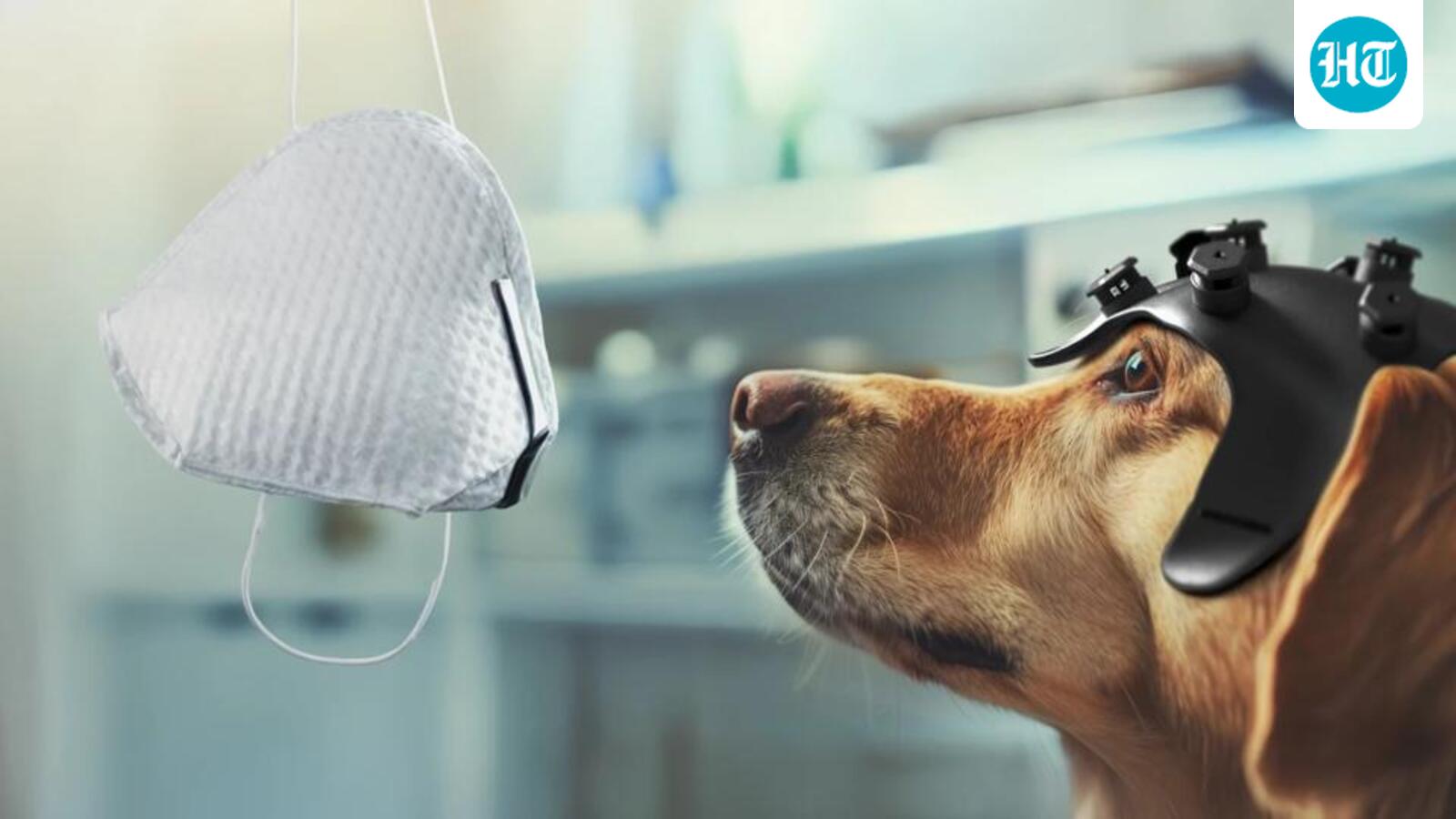
IT’s an unusual testing science lab. A rectangular elbow room with a jump in the midsection that doles come out dog treats. Around this is an oval green ramp with multiple small stations containing samples of human breath. In one corner, a dog trainer puts an EEG helmet and harness that measures neurobehavioural signatures on Chloe, a 2-year-old beagle, who is the star of this session.Once released, Chloe, heads to the chute to check for treats, doesn’t find anything, goes around the oval walkway, stopping at the 12 different stations to sniff samples of human breaths. Cameras in the ceiling and at each station record her ever move, velocity and sniff pattern. The harness and helmet she wears record her respiration, biomarkers and EEG.Finally, she sniffs a sample which has cancer, and heads to the chute again. This time, there’s a treat waiting for her. The whole exercise takes less than a minute. In that one minute, Chloe has smelled about 72 samples and recognized the one with cancer.We are in Dognosis’s farm in Neelamangala, outside Bengaluru, where fifteen dogs are being trained to smell and identify cancer from human breath. “It’s a weird technology,” acknowledges Itamar Bitan, co-founder and product lead, who is also the one who trains the dogs.Most technicians and hospitals are used to blood, urine and breath samples sent to labs where they are analyzed by machines. In the startup’s case, because there is a biological mammal involved with individual moods and nuances, the efficacy of a test is suspect. “Since it’s unorthodox, it has to be 10x better than other tests for it to be adopted,” the 27-year-old acknowledges. Bitan, who is from Israel, worked in the Israeli army for four years till 2020 in the canine unit for bomb detection, did a similar startup in canine olfaction to smell out Covid-19, before starting Dognosis in India.Dogs can smell diseases, but how do they tell you?We’ve known for almost two decades that dogs can smell diseases in humans. Dog olfaction is remarkable. They have up to 300 million olfactory receptors. Humans have 5-6 million. Studies across the world have proven that dogs can sniff out volatile organic compounds (VOCs) of various diseases from cancers to Covid-19 to malaria to Parkinson’s disease.The roadblock is human interpretation of what dogs are smelling. Currently the canine olfaction technology needs a dog to express what it’s smelling and a trained human to analyse what the dog’s communicating. Dognosis wants to standardise this process using video data, sensors, AI and machine learning. “Can we build data from sensors and put machine learning models on it to predict and analyse dog behaviour and their mental state through their facial features?” asks Akash Kulgod, the other co-founder of the startup.In 2023, Kulgod who is 26, contacted Bitan over LinkedIn with this idea and the duo started Dognosis. The startup raised $1.6 million from two venture capitalists who loved doing “crazy sci-fi ideas” giving them three years of runway to build the lab, the ML platform and a team of 50 employees, all aiming to validate their idea.The quest for olfaction standardisation The big gap in the technology – the reason that only three startups across the world are attempting it – is not only biological, it’s also that unlike in bombs where dogs are trained on specific chemicals, people haven’t been able to define the chemicals that the dogs are smelling to signal cancer. “These chemicals are very low resolution and variable across individuals and environments to quantify,” explains Bitan.Instead of decoding and annotating odors, whichhas thus far been an impossible problem, Dognosis maps out individual dogs using multiple sensors. Each dog has a digital twin, called Sniff Diary, with historical data, preferences, tendencies, behavioral and sensor data, respiration, brain data, movement as well as trainer annotations of each session. This data is fed into their ML system and analysed to find commonalities. The model creates customized signatures and tell-tales for each individual dog. “Our aim is to create individual dog imprints so we know that if this dog behaves a particular way in front of a sample, that means the sample is cancer positive,” says Bitan.To be cautious, each sample is sniffed by multiple dogs. The AI model combines the output of multiple dogs and gives results accordingly, giving less weightage to a dog if it’s not in a good mood behaviorally. Kulgod hopes that the AI trainer will become so good that it can identify something that the human trainer didn’t catch.In the last 18 months or so, the startup has partnered with six Karnataka based hospitals and run clinical trials on more than 3000 people. Earlier in April, they published a first-of-its-kind report in Journal of Clinical Oncology of a successful trial concluding that canine olfaction demonstrated high analytical accuracy in multi-cancer detection from breath. Kulgod could speed up the trial thanks to eleven doctors in the family. The oncologist who is the lead in the study, Dr Sanjeev Kulgod from RadOn Cancer Centre in Hubbali, is his uncle.Scaling canine olfactionCurrently, the startup has 15 dogs and can do half a million tests a year. “You can go from a dog not knowing anything, adopted from a shelter, to sniffing cancer in eight weeks,” says Kulgod, “and there’s no shortage of dogs.” The startup has a manual to find the motivated dogs who can do this repeatedly without getting bored. “They have to like food a lot,” says Bitan. Dogs have no salaries yet but they get dried meat, fruit, and veggies to keep their guts healthy, along with long walks, plenty of play time and regular vet visits. They work for 30 minutes in a day.Eight months ago, after feedback from their dogs, Dognosis engineered a new lab design to make it dog-friendly. The oval ramp we saw enables dogs to run around, reduces biases and enables quicker sniffs. Automating the sample swapping and presentation of 72 samples, makes it faster so dogs don’t get bored or frustrated with manual swapping or cleaning of stations, which was the case earlier. Higher number of samples also make sure that the dog catches at least one cancer sample and is rewarded, explains Bitan.Their collection process is also streamlined. Participants breathe into a mask for ten minutes which is then sealed into a container, cooled in a vaccine box, and brought to the lab to be stored at around 4-5 degree Celsius, before being presented to the dogs.Cancer is the holy grail of screening As a startup, Dognosis is aiming for the holy grail of screening tests – a multicancer screening test. “Cancer is the biggest, most mature market for preventative care, so that’s what we are focusing on,” says Bitan. Their aim is to create a home testing kit for the healthy population to feed into accepted screening tests. “Before a mammogram or a pap smear, you can use our test to just see if you have a possibility of cancer or not,” says Kulgod.Though one would think it’s easy, raising a new round of funds has been harder even after the study that proved their idea. “We spoke to 80-100 VCs and got a lot of rejections that said `dogs can’t be the future of medicine; dogs can’t scale; you can’t sell this product’,” says Kulgod, adding that the human bias that dogs can’t be standardized for a lab will continue even if they show that canine olfaction can be scaled and standardized.Despite the critics, the startup is working towards a product launch next year and plan to launch its at-home testing kit for cancer screening. “That’s the level of evidence we have,” says Bitan. Concurrently, the startup is collaborating with hospitals in different states in the country to run more clinical trials. Their lab is also being replicated in the UK at Medical Detection Dogs which has been doing trials of canine olfaction since 2004. They have finally secured an undisclosed tranche funding from a global venture capital to keep them going for the next three years.At the lab, a cat prowls around the territory looking at everyone with a democratic suspicion. No one has built a prediction, multimodal algorithm for canine olfaction before. “It’s pretty crazy,” reflects Kulgod, but so are other tests in the world. To detect cancer, a PET CT scan involves fasting, inserting a radiotracer into a patient’s vein, putting the person in a very expensive magnet, and analysing a lot of images that the machine creates. On the other hand, Dognosis test takes ten minutes of breathing in a mask to create a sample.“A dog can sniff 250 samples in 30 minutes, with each sample taking a few seconds and these dogs can be adopted from shelters and trained within eight weeks and all they ask for is dog food in return,” says Kulgod.Which technology is more sustainable, he asks.(Shweta Taneja tracks the evolving relationship between science, technology and modern society. She also works as a philanthropy researcher and advisor.)

Global News Perspectives
In today's interconnected world, staying informed about global events is more important than ever. ZisNews provides news coverage from multiple countries, allowing you to compare how different regions report on the same stories. This unique approach helps you gain a broader and more balanced understanding of international affairs. Whether it's politics, business, technology, or cultural trends, ZisNews ensures that you get a well-rounded perspective rather than a one-sided view. Expand your knowledge and see how global narratives unfold from different angles.
Customizable News Feed
At ZisNews, we understand that not every news story interests everyone. That's why we offer a customizable news feed, allowing you to control what you see. By adding keywords, you can filter out unwanted news, blocking articles that contain specific words in their titles or descriptions. This feature enables you to create a personalized experience where you only receive content that aligns with your interests. Register today to take full advantage of this functionality and enjoy a distraction-free news feed.
Like or Comment on News
Stay engaged with the news by interacting with stories that matter to you. Like or dislike articles based on your opinion, and share your thoughts in the comments section. Join discussions, see what others are saying, and be a part of an informed community that values meaningful conversations.
Download the Android App
For a seamless news experience, download the ZisNews Android app. Get instant notifications based on your selected categories and stay updated on breaking news. The app also allows you to block unwanted news, ensuring that you only receive content that aligns with your preferences. Stay connected anytime, anywhere.
Diverse News Categories
With ZisNews, you can explore a wide range of topics, ensuring that you never miss important developments. From Technology and Science to Sports, Politics, and Entertainment, we bring you the latest updates from the world's most trusted sources. Whether you are interested in groundbreaking scientific discoveries, tech innovations, or major sports events, our platform keeps you updated in real-time. Our carefully curated news selection helps you stay ahead, providing accurate and relevant stories tailored to diverse interests.

No comments yet.