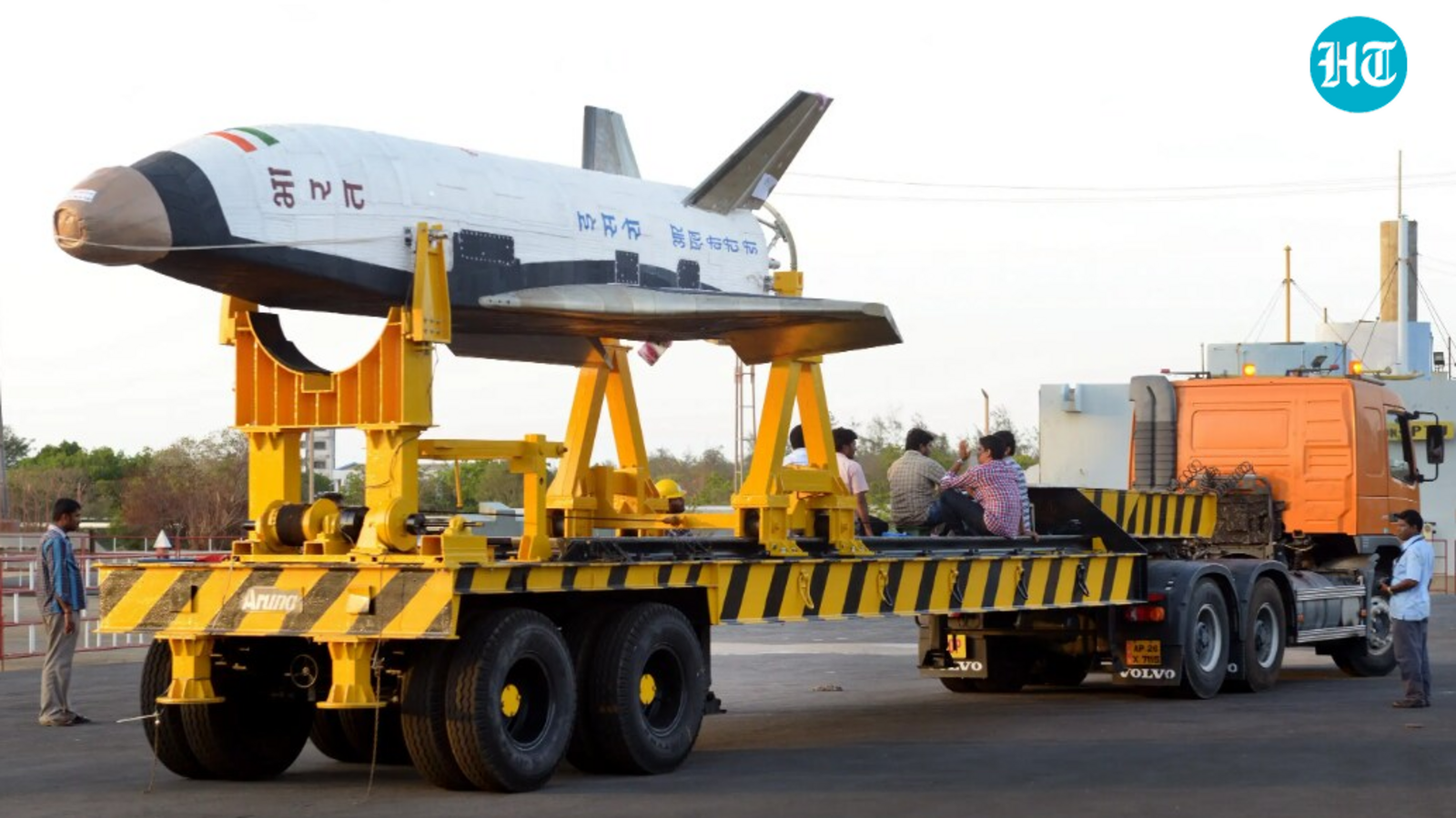
CHina's retrieval of a skyrocket lifter for the number one clip on Friday — using a net-and-hook system to catch the Long March-10B's returning first stage on a sea platform — has renewed attention on which nations and companies are chasing reusable rocket technology.China is only the second nation, after the US, to recover an orbital-class rocket booster intact. The company behind Friday’s launch, China Aerospace Science and Technology Corporation, is the third in the world to master the feat — after SpaceX’s Falcon 9 in 2015, and Blue Origin’s New Glenn in November 2025.India has a programme too, though there’s no confirmed timeline for it as yet.India's programmeThe Indian Space Research Organisation (Isro) began working on reusable launch vehicle (RLV) technology in 2010, with the long-term goal of a two-stage-to-orbit (TSTO) launch vehicle. Under the plan, the first stage of the rocket — instead of being discarded — would fly back and be reused.The programme's first key flight test came on May 23, 2016, when Isro launched the Reusable Launch Vehicle-Technology Demonstrator (RLV-TD) from Sriharikota, Andhra Pradesh.The winged vehicle, similar to an aircraft with a fuselage, nose cap, double delta wings and twin vertical tails, was boosted to Mach 5 by a conventional solid booster before being released to test hypersonic flight, autonomous navigation and a reusable thermal protection system.Isro said that under the mission, known as HEX, the vehicle glided down towards a hypothetical runway over the Bay of Bengal. A precise landing on an actual runway was not among the mission's objectives, which meant that HEX validated the physics of hypersonic re-entry, but did not record an actual recovery.Isro returned to the runway-landing test seven years later. On April 2, 2023, it conducted the RLV Autonomous Landing Mission (RLV LEX) at the Aeronautical Test Range in Chitradurga, Karnataka.Also read: Over a decade after SpaceX, China successfully lands rocket booster with hooks & a net. How different is the tech? An Indian Air Force Chinook helicopter carried the winged RLV to an altitude of 4.5 km and released it mid-air. The vehicle then used its onboard navigation, guidance and control systems to approach and land autonomously on the airstrip, touching down at a landing speed of roughly 350 km per hour.Isro described the helicopter-drop method as a world first for a winged body.A second, tougher version of the test — RLV LEX-02 — followed on March 22, 2024, at the same range. This time, the winged vehicle, named Pushpak, was deliberately released off its ideal flight path — both sideways and along its approach line — to test whether it could correct course entirely on its own.It could. The vehicle adjusted mid-flight and landed precisely on the runway, braking to a stop using a parachute, its landing-gear brakes and a steerable nose wheel.The same airframe and flight systems used in LEX-01 were reused for LEX-02 after recertification, demonstrating the reusability of the flight hardware itself.S. Unnikrishnan Nair, then the director of Vikram Sarabhai Space Centre (VSSC) — Isro's lead centre for launch vehicle design — had said in an official statement that the repeated success helped Isro master autonomous terminal-phase manoeuvring and energy management, a critical step towards the agency's future missions.The next step is the planned RLV Orbital Re-entry Experiment (ORE), in which an orbital re-entry vehicle would be carried into orbit atop an ascent stage built using technology already proven on Isro's existing GSLV and PSLV rockets. It would then stay in orbit for a set period, before re-entering and landing autonomously on a runway: the first genuine test of an orbital-class Indian RLV. No date is known for this.Also read: India and Pakistan: Space competition and governance challenge How the technology differsThe three programmes — by the US's SpaceX, China, and India — are meant to recover a spent rocket stage intact, but with three different approaches.SpaceX's Falcon 9 booster performs a powered, vertical descent. Its Merlin engines execute a series of braking burns, and the booster touches down upright on landing legs, either on a ground pad or a floating drone ship.Also read: Vikram-1, India’s first private orbital rocket to launch this month China's Long March-10B booster also returns vertically under engine power, but instead of legs, it deploys four hooks that catch a net strung across a sea-based platform — a design that its maker says simplifies the rocket’s onboard structure, cuts its mass, and adds payload capacity.Both are, fundamentally, propulsive landings: the rocket's own engines do the work of slowing and controlling the final descent.India's RLV differs fundamentally. It is an unpowered glider in its last phase, with Isro describing it as a “space plane” with a low lift-to-drag ratio and no engine fires during the landing itself. It is a lifting body that uses its wings, elevons (flaps on the trailing edge of the wings) and rudder to control an aerodynamic descent, much like an aircraft or a scaled-down space shuttle, before touching down horizontally on a runway using conventional landing gear, brakes and a parachute.There is no landing burn — the rocket-engine fire that SpaceX and China use to slow their boosters — and no vertical touchdown at all.Isro says the winged vehicle is a prototype that is meant to be scaled up into the first stage of a fully reusable two-stage orbital launch vehicle — conceptually similar to SpaceX and China's approach, but arriving back on Earth by a completely different route.Also read: Before India's space milestone, Isro had to put a 673kg satellite on a bullock cart Where the programme standsSpaceX has been recovering and reflying Falcon 9 boosters routinely for a decade. China achieved its first-ever orbital-class booster recovery only on Friday — but it happened during an actual orbital satellite launch. India has not yet attempted an orbital-class recovery.Asked about the programme in February this year, Isro chairperson V. Narayanan said the space agency does not see itself as racing SpaceX. “We don't consider this as competition with anybody," he told reporters in Pune, while acknowledging that reusable rockets are more cost-effective and that Isro was actively working towards the technology.He described the programme as being at an experimental stage, without offering a timeline for operational deployment. The remarks came as Isro was also working through recent setbacks with its workhorse PSLV rocket after two mission failures in May 2025 and January 2026.

Global News Perspectives
In today's interconnected world, staying informed about global events is more important than ever. ZisNews provides news coverage from multiple countries, allowing you to compare how different regions report on the same stories. This unique approach helps you gain a broader and more balanced understanding of international affairs. Whether it's politics, business, technology, or cultural trends, ZisNews ensures that you get a well-rounded perspective rather than a one-sided view. Expand your knowledge and see how global narratives unfold from different angles.
Customizable News Feed
At ZisNews, we understand that not every news story interests everyone. That's why we offer a customizable news feed, allowing you to control what you see. By adding keywords, you can filter out unwanted news, blocking articles that contain specific words in their titles or descriptions. This feature enables you to create a personalized experience where you only receive content that aligns with your interests. Register today to take full advantage of this functionality and enjoy a distraction-free news feed.
Like or Comment on News
Stay engaged with the news by interacting with stories that matter to you. Like or dislike articles based on your opinion, and share your thoughts in the comments section. Join discussions, see what others are saying, and be a part of an informed community that values meaningful conversations.
Download the Android App
For a seamless news experience, download the ZisNews Android app. Get instant notifications based on your selected categories and stay updated on breaking news. The app also allows you to block unwanted news, ensuring that you only receive content that aligns with your preferences. Stay connected anytime, anywhere.
Diverse News Categories
With ZisNews, you can explore a wide range of topics, ensuring that you never miss important developments. From Technology and Science to Sports, Politics, and Entertainment, we bring you the latest updates from the world's most trusted sources. Whether you are interested in groundbreaking scientific discoveries, tech innovations, or major sports events, our platform keeps you updated in real-time. Our carefully curated news selection helps you stay ahead, providing accurate and relevant stories tailored to diverse interests.

No comments yet.