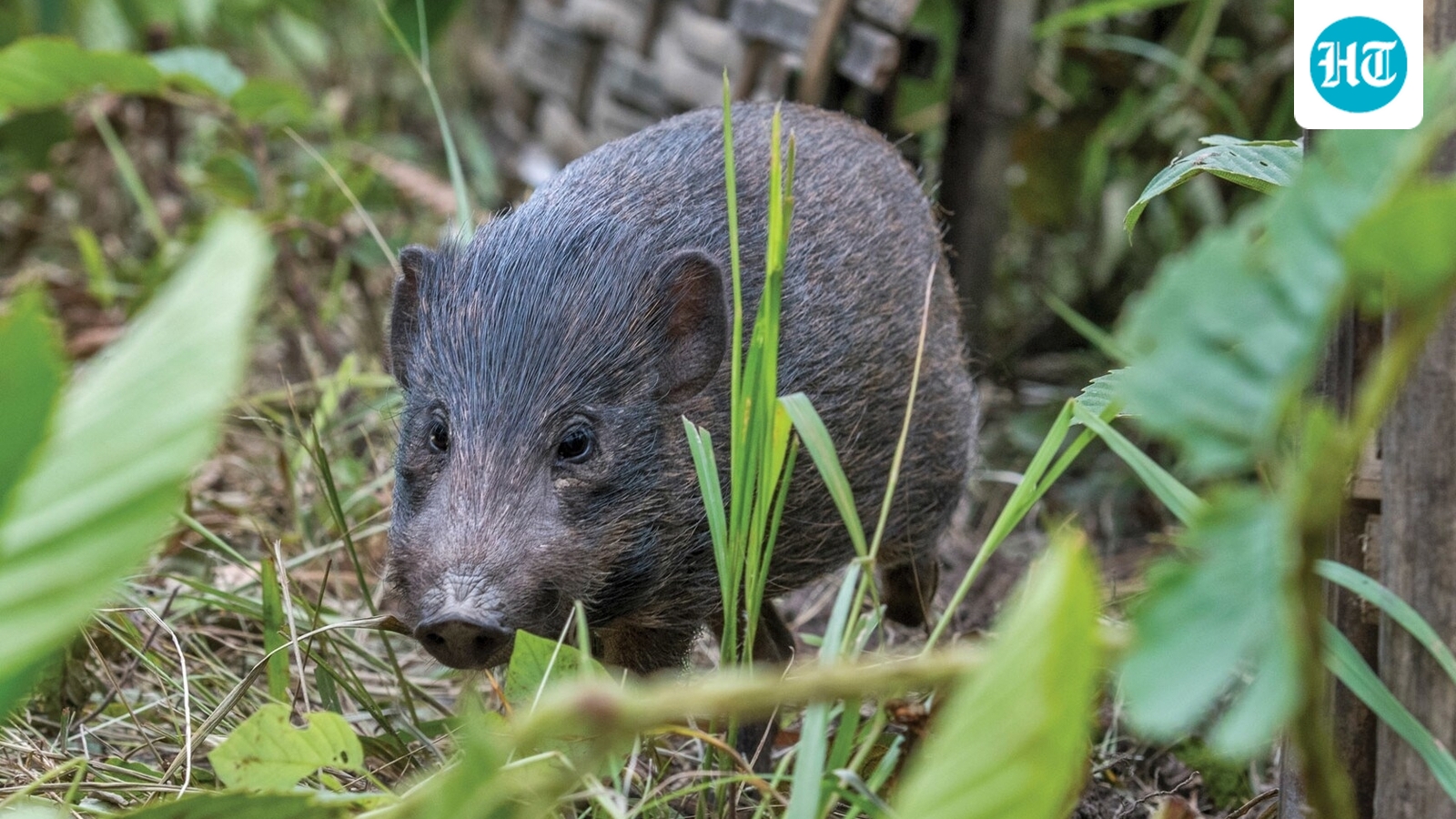
THe only if known method to get them unscathed was to even them come out of the dense cover of grass and into a line of nets. For vantage, some among the catchers needed to be on elephants, while others walked alongside to herd the tiny trotters with loud noises. In 1996, a team caught hold of six pygmy hogs from Assam's Manas National Park, and drove them to a newly built breeding centre at Basistha, on the outskirts of Guwahati.The shy, dark-brown wild pig, scarcely bigger than a house cat, was so elusive that experts had assumed for two decades the species was already extinct. The capture, at the time, was a roll of the dice, so conservationalists could some day introduce the world’s tiniest hogs back into the wild.Three decades on, that gamble is one of India's quieter conservation successes. Union environment minister Bhupender Yadav announced this week that the pygmy hog will be added to the list of ‘critically endangered’ species under a centrally sponsored scheme – Integrated Development of Wildlife Habitats (CSS-IDWH) – potentially helping unlock funding for their protection.The species — sole representative of the genus Porcula, first described by naturalist Brian Houghton Hodgson in 1847 — is one whose extinction would have erased an entire evolutionary lineage of wild pigs, conservationists say.A pig built to disappearAdult pygmy hogs (porcula salvania) are just 60-65 cm in length and about 25 cm at the shoulder. Males weigh 8-9 kg,10 to 15 times lighter than a wild boar, and newborns, just about 150-200 grams.They live in small family units of four to six — one or two adult females with their young, and occasionally an adult male — and are unusual among pigs in building and using grass nests the entire year, not only to give birth. Litters are born typically just before the monsoon and number three or four young after a five-month gestation.Locally known asnol gahori ortakuri borah in Assamese and oma thakhri in Bodo, the pygmy hog proved so evolutionarily distinct that genetic studies only later confirmed what Hodgson had proposed back in the 19th century — that the species belongs in its own genus.Also read: Sikkim: Eurasian Lynx captured on cam for 1st time; 2nd record in eastern HimalayasWhy a tiny pig mattersIt isn't to do with their size.In the wet grasslands of the sub-Himalayan terai and duar belt, the pygmy hog functions as what the Durrell Wildlife Conservation Trust calls an indicator species — one whose decline signals trouble in the ecosystem. The same grasslands sustaining them are also critical habitat for the greater one-horned rhinoceros, tigers, eastern barasingha, wild water buffalos, hispid hare and Bengal florican, a 2023 paper in the GUINEIS Journal by scientists Dhritiman Das, Jonmani Kalita and Parag Jyoti Deka noted. This makes the hog’s fate a proxy for the health of one of the subcontinent’s richest, most threatened habitat types. The wet grasslands act as a buffer for monsoon floods and drive the groundwater tables that farming communities depend on, the paper added.Deka is the project director of India’s pygmy hog conservation programme, and Kalita and Das are deeply involved too.The hogs play another key role. When they root for tubers, insects and eggs, they inadvertently aerate grassland soil and help disperse seeds, the environmental magazine Down To Earth reported in a December 2025 article.A near-collapse and the long road backThe pygmy hog once lived in a narrow belt spanning from south-eastern Uttarakhand and the Nepal terai through Bihar and north Bengal to central Assam. But, by the 1960s, the species was feared extinct.A 1971 rediscovery near Barnadi Wildlife Sanctuary and in Manas offered brief hope, and late-1970s surveys found small populations elsewhere in Assam's reserve forests. But uncontrolled dry-season burning, combined with grasslands turned into farmlands and settlements, livestock grazing, thatch harvesting, flood-control schemes, hunting and ethnic conflict wiped out population after population. Barnadi's hogs were gone by the early 1990s, and by 1993, the species survived only in scattered pockets of Manas.It was in 1995 that the Pygmy Hog Conservation Programme (PHCP) was formed by the Durrell Trust, the IUCN/SSC Wild Pig Specialist Group, the Assam forest department and the Union environment ministry, and later joined by non-profits EcoSystems-India and Aaranyak.Under the programme, they set out to breed the species in captivity at Basistha and eventually re-introduce them into the wild.A second breeding centre and a purpose-built “pre-release” facility set up near Assam's Nameri National Park, where captive-born hogs spend five to six months in near-natural enclosures to re-learn how to forage and survive in the wild.Reintroductions began at Sonai Rupai Wildlife Sanctuary in 2008, followed by Orang National Park (2011),Barnadi Wildlife Sanctuary (2016) and, in a symbolic homecoming, Manas's Bhuyanpara range from 2020.Between 2008 and 2023, 170 captive-bred hogs were released across these four Assam sites, the GUINEIS Journal study said.The exact numbers are unknown because the animals are notoriously secretive, and any monitoring relies on camera traps, nest surveys and radio transmitters attached onto some hogs released after captivity.Also read: Study identifies climate-resilient reefs worldwide, calls for better protection Field surveys have put the reintroduced population in Orang at over 120 in the years following release, and at more than 250 by early 2026, according to Down To Earth. In Manas, there may be an estimated 100-150, and around 70 to 90 hogs are kept at all times at the breeding centre in Basistha.Based on India’s conservation story, the International Union for Conservation of Nature (IUCN) upgraded the pygmy hog's global Red List status from 'critically endangered' to 'endangered' in 2016.What still threatens themWhile the efforts have led to clear gains, a 2023 assessment gave the pygmy hog a species recovery score of just 8%, categorised as 'critically depleted’, the GUINEIS study noted. The tag was a reminder that captive breeding has kept the species alive, but their numbers can't flourish widely until grasslands are restored.Another threat is African swine fever, which reached Assam in 2020, and is capable of wiping out the hogs. Because of it, biosecurity at the captive centres has become an existential concern.For a species already rescued once from the edge, the next chapter might depend less on saving individual hogs than on saving the grasslands they, and dozens of other threatened species, still call home.

Global News Perspectives
In today's interconnected world, staying informed about global events is more important than ever. ZisNews provides news coverage from multiple countries, allowing you to compare how different regions report on the same stories. This unique approach helps you gain a broader and more balanced understanding of international affairs. Whether it's politics, business, technology, or cultural trends, ZisNews ensures that you get a well-rounded perspective rather than a one-sided view. Expand your knowledge and see how global narratives unfold from different angles.
Customizable News Feed
At ZisNews, we understand that not every news story interests everyone. That's why we offer a customizable news feed, allowing you to control what you see. By adding keywords, you can filter out unwanted news, blocking articles that contain specific words in their titles or descriptions. This feature enables you to create a personalized experience where you only receive content that aligns with your interests. Register today to take full advantage of this functionality and enjoy a distraction-free news feed.
Like or Comment on News
Stay engaged with the news by interacting with stories that matter to you. Like or dislike articles based on your opinion, and share your thoughts in the comments section. Join discussions, see what others are saying, and be a part of an informed community that values meaningful conversations.
Download the Android App
For a seamless news experience, download the ZisNews Android app. Get instant notifications based on your selected categories and stay updated on breaking news. The app also allows you to block unwanted news, ensuring that you only receive content that aligns with your preferences. Stay connected anytime, anywhere.
Diverse News Categories
With ZisNews, you can explore a wide range of topics, ensuring that you never miss important developments. From Technology and Science to Sports, Politics, and Entertainment, we bring you the latest updates from the world's most trusted sources. Whether you are interested in groundbreaking scientific discoveries, tech innovations, or major sports events, our platform keeps you updated in real-time. Our carefully curated news selection helps you stay ahead, providing accurate and relevant stories tailored to diverse interests.

No comments yet.