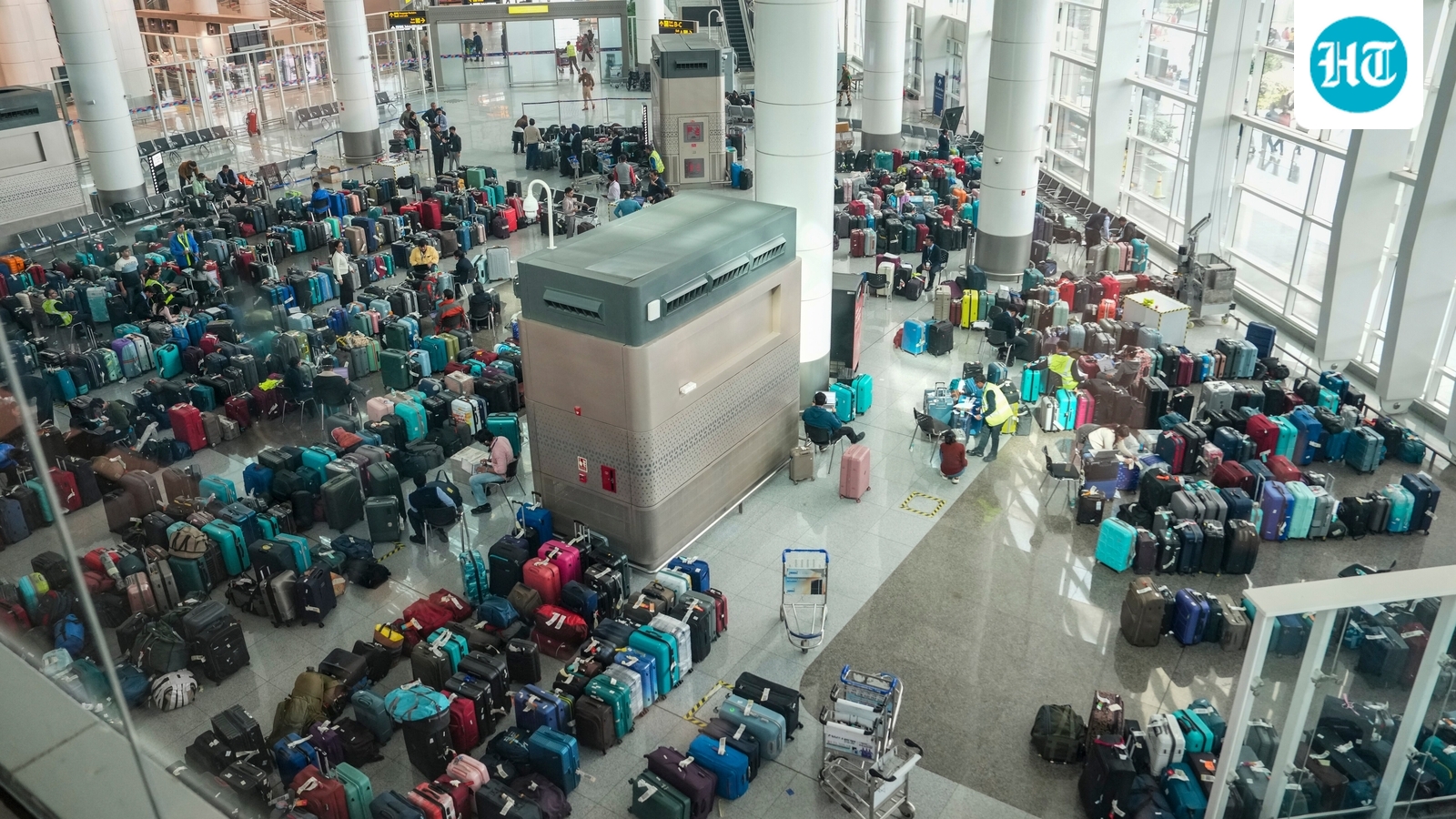
INdiGo flights cancelled unrecorded: Replying to a call into question in the Rajya Sabha, civic air power government minister Ram Mohan Naidu said IndiGo’s internal system was responsible for the crisis that resulted in large scale flight cancellations. He added that he wants more players in the aviation industry in reply to a query about IndiGo holding over 60% of the market share.On Monday, nearly 500 IndiGo flights were cancelled as the airline’s operational disruptions continued for the seventh day.IndiGo, India’s largest airline, is dealing with a massive operational crisis that has led to mass cancellation and rescheduling of flights since Tuesday last week.The airline expects operations to stabilise by December 10.ALSO READ | Why did govt norms not hit other airlines as bad as IndiGo?IndiGo flight cancellations: Key pointsNearly 500 flights have been cancelled on Monday, with Delhi and Bengaluru being the worst-hit with more than 100 flight cancellations each. On Sunday, around 650 flights were cancelled while several others were rescheduled. Notably, the airline has cancelled more than 2,000 flights since Tuesday last week.Civil aviation minister, speaking in the Rajya Sabha on Monday, blamed IndiGo's internal planning system and problems in its crew rostering for the crisis.The Supreme Court refused an urgent hearing related to the IndiGo chaos on Monday. It said that the Centre had taken cognisance and timely steps to address the issue.On Monday, the Delhi airport warned that IndiGo may continue to experience more delays and advised passengers to check the latest flight status before heading to the airport.The disruption to IndiGo flights was mainly caused by the airline’s lack of preparation for the new pilot rest rules known as Flight Duty Time Limitations (FDTL) which came into effect on November 1, 2025, the Directorate General of Civil Aviation (DGCA) said.The DGCA has issued show-cause notices to IndiGo CEO Pieter Elbers and the firm's accountable manager over the large-scale disruptions, asking them to respond within 24 hours. However, the aviation regulator granted them a 24-hour extension after the airline sought more time to respond.IndiGo said in a statement on Sunday that it expects its network to stabilise by December 10.In a video message to staff on Sunday, IndiGo CEO Pieter Elbers said that "step by step, we are getting back" and added that the airline’s on time performance is expected to reach 75 per cent.IndiGo issued refunds totalling ₹610 crore for cancelled and delivered 3,000 pieces of baggage to passengers across the country, the government said on Sunday.The civil aviation ministry, which has taken steps such as putting caps on airfares and asking IndiGo to speed up the refund process, said on Sunday that air travel operations across the country are improving quickly.

Global News Perspectives
In today's interconnected world, staying informed about global events is more important than ever. ZisNews provides news coverage from multiple countries, allowing you to compare how different regions report on the same stories. This unique approach helps you gain a broader and more balanced understanding of international affairs. Whether it's politics, business, technology, or cultural trends, ZisNews ensures that you get a well-rounded perspective rather than a one-sided view. Expand your knowledge and see how global narratives unfold from different angles.
Customizable News Feed
At ZisNews, we understand that not every news story interests everyone. That's why we offer a customizable news feed, allowing you to control what you see. By adding keywords, you can filter out unwanted news, blocking articles that contain specific words in their titles or descriptions. This feature enables you to create a personalized experience where you only receive content that aligns with your interests. Register today to take full advantage of this functionality and enjoy a distraction-free news feed.
Like or Comment on News
Stay engaged with the news by interacting with stories that matter to you. Like or dislike articles based on your opinion, and share your thoughts in the comments section. Join discussions, see what others are saying, and be a part of an informed community that values meaningful conversations.
Download the Android App
For a seamless news experience, download the ZisNews Android app. Get instant notifications based on your selected categories and stay updated on breaking news. The app also allows you to block unwanted news, ensuring that you only receive content that aligns with your preferences. Stay connected anytime, anywhere.
Diverse News Categories
With ZisNews, you can explore a wide range of topics, ensuring that you never miss important developments. From Technology and Science to Sports, Politics, and Entertainment, we bring you the latest updates from the world's most trusted sources. Whether you are interested in groundbreaking scientific discoveries, tech innovations, or major sports events, our platform keeps you updated in real-time. Our carefully curated news selection helps you stay ahead, providing accurate and relevant stories tailored to diverse interests.

No comments yet.