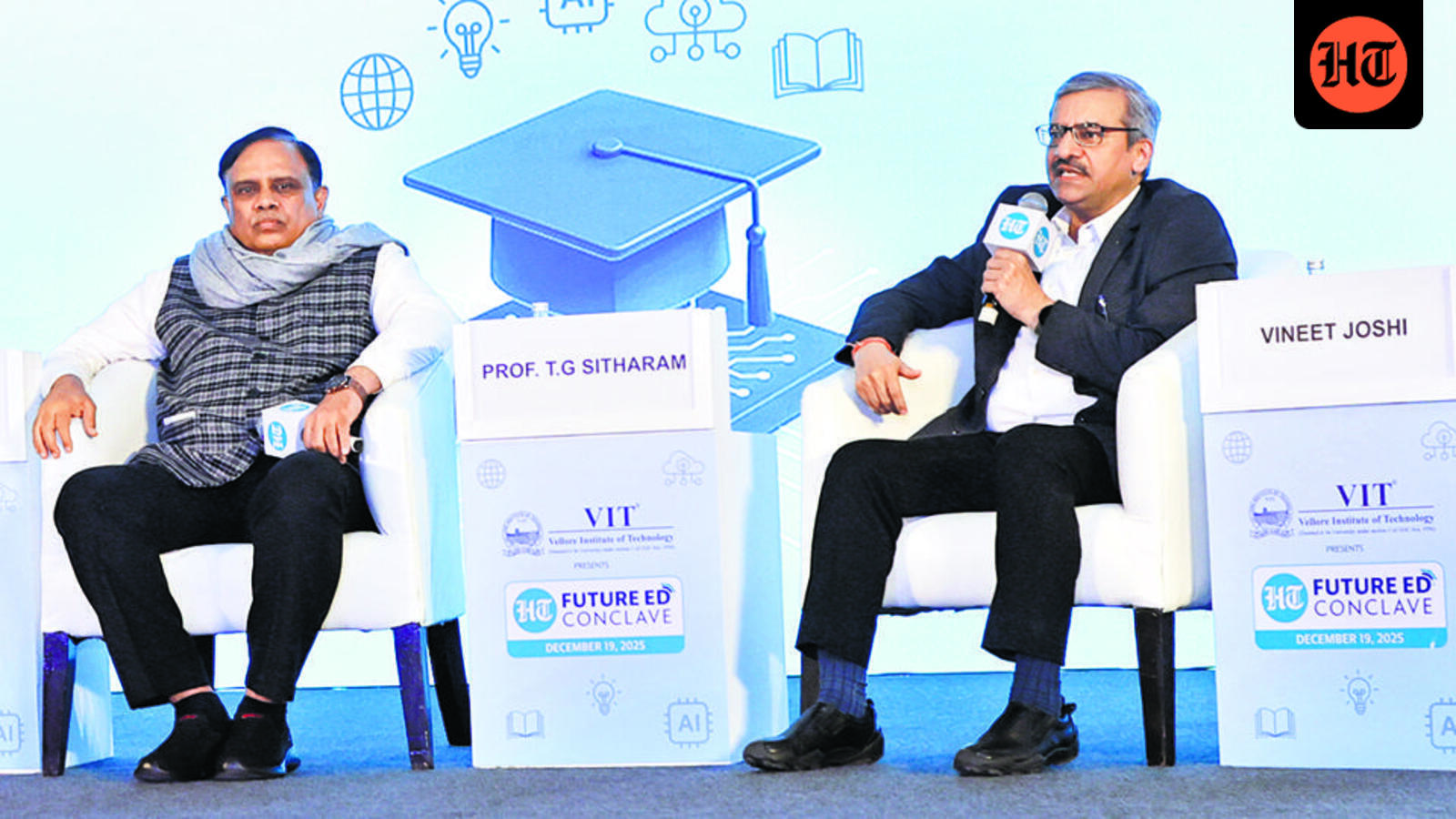
THe Viksit Bharat Shiksha Adhishthan (VBSA) government note, 2025, is intended to decentralise ordinance and reposition greater responsibleness and self-sufficiency to colleges and universities, rather than concentrating power in a single authority, Vineet Joshi, secretary in the department of higher education and chairman of the University Grants Commission (UGC), said on Friday.Speaking at a session titled “Strengthening Higher Education Through Technology” at the HT Future-Ed Conclave, Joshi said the new legislative framework aims to simplify India’s fragmented regulatory architecture while empowering institutions to take ownership of outcomes. “It is not going to be that one body becomes over-centralised. On the contrary, it decentralises authority to the institution itself. It is the institution that declares the correct data and moves forward on that basis,” he said.The intent of the bill, Joshi said, is to replace a maze of multiple regulators with a streamlined system without diluting expertise. “The proposal is to simplify regulation so that institutions deal with one regulator instead of 14 or 15. At the same time, experts from all disciplines will be part of that framework,” he said, adding that concerns around excessive centralisation were misplaced. “I don’t think there should be any fear about it.”Framing the discussion around outcomes, Prof TG Sitharam, chairman of the All India Council for Technical Education (AICTE), said India’s higher education system already commands global attention because of the depth of its young talent pool, particularly in emerging technologies. “We have a very large number of talented young people in artificial intelligence and data science. Our human capital is very high today, and that is what the whole world is looking at,” he said.Pointing to the presence of Indian engineers across global firms, Sitharam said this talent advantage is driving investment decisions. “You go to any major company and our engineers are there. Many large companies are coming and establishing operations here, some of them hiring tens of thousands of engineers. This clearly shows there is no lacuna in the training of our students,” he said.Joshi placed this confidence in India’s talent pipeline within the broader reforms triggered by the National Education Policy (NEP) 2020, which he said marked a decisive shift towards a student-first approach. “NEP very categorically said that the student is at the centre,” he said. “In today’s circumstances, where the world is changing so fast, students also have to learn fast. Learning, unlearning and relearning is going to be a continuous cycle.”He said every major policy change since 2020 has flowed from this principle. “When you keep the student in mind, you understand the importance of reforms like the Viksit Bharat Shiksha Adhishthan… Similarly, when we talk about bringing in technologies such as artificial intelligence or quantum computing, it is again with the student at the centre. Ultimately, students will come out of institutions and they should either be able to create jobs or contribute meaningfully to the economy,” Joshi said.Approved by the cabinet on December 12, the VBSA Bill aims to replace three regulators, the University Grants Commission (UGC), the All India Council for Technical Education (AICTE), and the National Council for Teacher Education (NCTE), with a single body. It also seeks to regulate the establishment of higher educational institutes, imposing a fine of ₹2 crore on those who set up universities without proper government approval.Sitharam said the rapid transformation of skills and learning environments has also forced a rethink of the role of teachers, particularly in technology-driven disciplines. “The learning space has completely changed. Learning does not happen only through teacher-assisted methods anymore,” he said. “The role of teachers has fundamentally changed.”While younger students are already comfortable with technology, Sitharam said faculty members – especially from older generations – need structured support to adapt. “Our young people are born with smartphones in their hands. But the older generation was not fully ready, though Covid gave us a small push,” he said. To bridge this gap, Sitharam said AICTE has launched a series of training initiatives focused on technology and pedagogy.Joshi, meanwhile, said the evolving regulatory framework also links institutional autonomy to performance, particularly student outcomes. “We have said very clearly that autonomy will be linked to outcomes… If an institution is of high quality, it has every right to be more autonomous. If it is not, then autonomy will depend on how it performs.”This, he said, reflects changing societal expectations. “It is the student who is supreme. Universities that respond to these expectations will get more autonomy. Those that are slower will work their way up,” Joshi said.Joshi also pointed to enrolment data to underline gains in access and inclusivity. “There has been a significant improvement in access, and also in inclusivity,” he said, noting that enrolment growth among Scheduled Castes, Scheduled Tribes and Other Backward Classes has outpaced that of the unreserved category. Women’s participation has also risen sharply. “For six consecutive years, female gross enrolment has been higher than male enrolment,” he said, adding that the trend reflects a deeper structural shift in India’s higher education system.Looking ahead, Sitharam expressed confidence that these reforms will translate into global leadership. “Five years from now, I see India at the top when it comes to innovation and entrepreneurship,” he said.

Global News Perspectives
In today's interconnected world, staying informed about global events is more important than ever. ZisNews provides news coverage from multiple countries, allowing you to compare how different regions report on the same stories. This unique approach helps you gain a broader and more balanced understanding of international affairs. Whether it's politics, business, technology, or cultural trends, ZisNews ensures that you get a well-rounded perspective rather than a one-sided view. Expand your knowledge and see how global narratives unfold from different angles.
Customizable News Feed
At ZisNews, we understand that not every news story interests everyone. That's why we offer a customizable news feed, allowing you to control what you see. By adding keywords, you can filter out unwanted news, blocking articles that contain specific words in their titles or descriptions. This feature enables you to create a personalized experience where you only receive content that aligns with your interests. Register today to take full advantage of this functionality and enjoy a distraction-free news feed.
Like or Comment on News
Stay engaged with the news by interacting with stories that matter to you. Like or dislike articles based on your opinion, and share your thoughts in the comments section. Join discussions, see what others are saying, and be a part of an informed community that values meaningful conversations.
Download the Android App
For a seamless news experience, download the ZisNews Android app. Get instant notifications based on your selected categories and stay updated on breaking news. The app also allows you to block unwanted news, ensuring that you only receive content that aligns with your preferences. Stay connected anytime, anywhere.
Diverse News Categories
With ZisNews, you can explore a wide range of topics, ensuring that you never miss important developments. From Technology and Science to Sports, Politics, and Entertainment, we bring you the latest updates from the world's most trusted sources. Whether you are interested in groundbreaking scientific discoveries, tech innovations, or major sports events, our platform keeps you updated in real-time. Our carefully curated news selection helps you stay ahead, providing accurate and relevant stories tailored to diverse interests.

No comments yet.