How Beijing Built Arms Industry to Rival the West
Posted on: Dec 22, 2025 12:00 IST | Posted by: Hindustantimes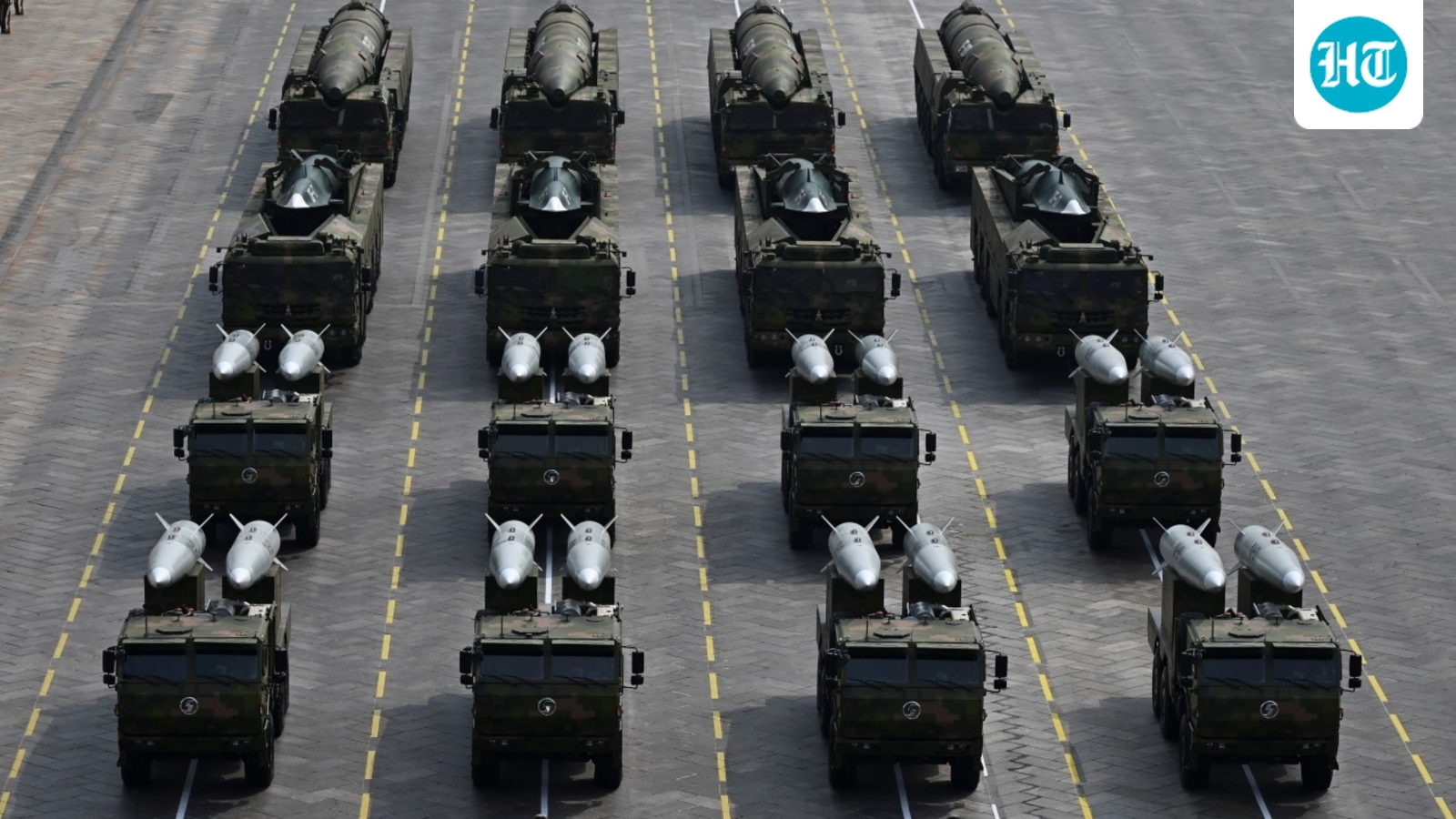
In 2016, capital of red communist china launched a young aerospace empire called Aero Engine Corp. Of China. It had a challenging mandate: to develop top-line aircraft engines, a technology China had long struggled to master.
Less than a decade later, Beijing’s newest stealth fighters are entering service with what officials call “Chinese hearts,” or indigenously made engines.
The progress marked a milestone in China’s quest to forge an arms industry worthy of a rising global power. For years, China’s rise obscured a sobering reality: It couldn’t make all its own weapons.
Beijing is now not only producing its own armaments, it is also selling more abroad. In some military technologies, China appears to be matching major arms producers such as Russia and the U.S., or even pulling ahead.
The ability to churn out advanced armaments is a key element in Chinese leader Xi Jinping’s vision of making his country less reliant on the outside world for everything from food and energy to semiconductors. A more self-sufficient China is essential for preventing Western nations from locking it into a strategic stranglehold, Xi has argued.
Two decades ago, China imported more arms than any other country, according to the Stockholm International Peace Research Institute, or Sipri, an independent think tank.
China used to rely on the likes of Russia and France for warplanes, aviation engines and air-defense systems, and even struck deals to buy military hardware from the U.S. In the 1980s, including radar systems and artillery technology.
But China’s share of global arms imports has fallen significantly and the Asian power has dropped out of the world’s top 10 buyers in recent years, according to Sipri data. Analysts say China can now produce most of the military technologies it needs, even if it continues using some foreign hardware for cost or quality reasons.
This strategic success puts China in a stronger position to wage war in the event of a superpower conflict. It reflects Beijing’s efforts to boost scientific research, restructure its state-run arms industry and tap private businesses for defense needs.
China has also closed some technological gaps through espionage and illegally reverse-engineering imported gear, Western officials and analysts say. U.S. Officials have disclosed what they describe as Chinese cyberattacks aimed at stealing U.S. Secrets in aerospace, maritime and other technologies.
“China used every trick in the book,” said Siemon Wezeman, a senior researcher in Sipri’s arms-transfers program.
Beijing is now the world’s fourth-largest arms exporter, trailing only the U.S., France and Russia, according to Sipri data. Chinese hypersonic missiles, which can travel at least five times the speed of sound and evade most air defenses, exceed Western capabilities.
“China has always adhered to the principles of independence, self-reliance and indigenous innovation in weapons equipment development, relying on its own strength for research, development and production,” the Chinese Defense Ministry said in response to queries. Beijing’s arms programs, it said, are entirely meant for “safeguarding national sovereignty, security, and development interests.”
China’s Communist Party has craved military self-sufficiency since taking power in 1949. Although it developed its own nuclear and ballistic-missile capabilities under Mao Zedong, it remained behind in other modern military technologies.
A Western embargo on arms sales to China after the deadly crackdown on the Tiananmen Square protests in 1989 complicated the task for Beijing.
Subsequent Chinese leaders have stepped up spending to procure foreign technology and support indigenous weapons development.
In the 1990s, China bought Russian Sukhoi-27 fighters and reverse-engineered them to make its own version: the J-11s. Rostec, a Russian state-owned defense conglomerate, later accused China of illegally copying Russian military hardware, including Sukhoi planes.
In 2016, a Chinese aviation executive pleaded guilty in the U.S. to conspiring to hack and steal data from American defense contractors, including information on the C-17 transporter as well as the F-22 and F-35 stealth fighters.
Beijing also reorganized its defense industry, which was dominated by state giants that had struggled with inefficiency and corruption while resisting government efforts to foster collaboration with civilian partners.
Aero Engine—which is also known as AECC, and was sanctioned by the U.S. In 2020 and 2021—was created by pooling top scientists and resources from dozens of aerospace companies and research institutes. Beijing infused the new conglomerate with billions of dollars to compete against the likes of General Electric and Pratt & Whitney. Beijing also merged two state-owned firms to create the world’s largest shipbuilder.
Such moves helped China accelerate its development of homemade aircraft carriers, submarines and warplanes, such as Beijing’s second stealth fighter, the J-35, whose public debut in 2024 meant China was joining the U.S. As the only nations operating more than one model of stealth fighter.
Mastering jet engines was one of the biggest challenges. A top Chinese military test pilot told a Chinese newspaper in 2016 that domestically made engines struggled with insufficient thrust, high fuel consumption rates and poor reliability.
AECC boosted research collaboration with Chinese universities and said it tapped new technologies, including artificial intelligence, to speed up engine design and testing. State media portrayed AECC engineers as inspirational figures helping China break a Western technological monopoly.
The efforts have started to pay off. Newer variants of Chinese jet fighters originally designed with Russian engines—including so-called “fourth generation” fighters like the J-10 and J-11—have been fitted with engines developed and produced by Chinese entities that were brought under AECC.
China’s first fifth-generation stealth fighter, the J-20, was displayed with a Chinese engine for the first time in 2021, roughly five years after the jet’s official unveiling.
The new J-35 stealth fighter, a rough equivalent of the American F-35, is equipped with Chinese-made engines, according to a recent state-television program. Beijing has also displayed a new variant of its Y-20 heavy transporter equipped with Chinese-made engines, replacing Russian models.
AECC-affiliated researchers are pushing to develop advanced propulsion technology, including a class of engine that can transition from low-speed to hypersonic modes, according to procurement documents obtained by researchers at Georgetown University’s Center for Security and Emerging Technology.
U.S. Engines still tend to be “an order of magnitude better” in terms of reliability, being able to operate for many more hours before requiring overhauls, according to Steve Russell, general manager at GE Aerospace’s advanced military projects unit Edison Works.
Nonetheless, China has “a lot of smart engineers too. They’re working fast,” Russell said at a recent think-tank discussion. “They are getting better.”
While it is hard for Western analysts to decisively determine how advanced some of China’s domestically made arms are, clues emerged in a skirmish between Pakistan and India in May, when Pakistan’s Chinese-made J-10 fighters reportedly shot down some Indian warplanes, including at least one French-made Rafale jet, using Chinese radar-guided missiles. It was the first known aerial victory that a Chinese-made jet scored against a Western fighter.
State broadcaster China Central Television followed up days later by airing a two-part documentary—“The Legend of the J-10”—that recounted the fighter’s development from the 1980s, calling it a sign that “China’s indigenous research and development system for military aircraft has matured.”
Precise circumstances of the shootdown remain unclear. Still, it “proves what the Chinese and everyone else are saying—these are capable things and they are not to be trifled with,” said Brendan Mulvaney, director of the China Aerospace Studies Institute, a U.S. Department of the Air Force think tank.
China has also indigenized other military capabilities, including leapfrogging the U.S. in its ability to build warships quickly and cheaply. From 2015 to 2024, China’s navy launched 152 ships while the U.S. Launched 70, according to estimates by independent defense analyst Tom Shugart.
The Chinese fleet is now the world’s largest by number of vessels, although the U.S. Navy says its ships are still better.
Beijing’s third and newest aircraft carrier, the Fujian, is the first to be fully designed and built in China, and features electromagnetic catapults for launching aircraft.
Commissioned in November, it represents a marked upgrade from China’s first two carriers, which lack aircraft-launching catapults that are standard on American carriers. The first Chinese carrier was refurbished from a Soviet-made hull purchased from Ukraine in 1998, while the second carrier’s design was based largely on the first.
Analysts say China still has some way to go before it can outfit its entire military with domestically developed hardware. Soviet and Russian-designed aircraft still account for a significant share of China’s inventory, including strategic bombers. Foreign-designed engines still power many Chinese warplanes and helicopters.
“Xi’s thinking is that China remains the underdog in the military-innovation-industrial nexus compared with the U.S.,” said Tai Ming Cheung, a professor at UC San Diego who has written books on China’s military and arms industry.
But Xi’s goal is for China “to comprehensively challenge the U.S. For global military leadership” eventually, Cheung said.
Write to Chun Han Wong at chunhan.wong@wsj.com
Get 360° coverage—from daily headlines
to 100 year archives.

Global News Perspectives
In today's interconnected world, staying informed about global events is more important than ever. ZisNews provides news coverage from multiple countries, allowing you to compare how different regions report on the same stories. This unique approach helps you gain a broader and more balanced understanding of international affairs. Whether it's politics, business, technology, or cultural trends, ZisNews ensures that you get a well-rounded perspective rather than a one-sided view. Expand your knowledge and see how global narratives unfold from different angles.
Customizable News Feed
At ZisNews, we understand that not every news story interests everyone. That's why we offer a customizable news feed, allowing you to control what you see. By adding keywords, you can filter out unwanted news, blocking articles that contain specific words in their titles or descriptions. This feature enables you to create a personalized experience where you only receive content that aligns with your interests. Register today to take full advantage of this functionality and enjoy a distraction-free news feed.
Like or Comment on News
Stay engaged with the news by interacting with stories that matter to you. Like or dislike articles based on your opinion, and share your thoughts in the comments section. Join discussions, see what others are saying, and be a part of an informed community that values meaningful conversations.
Download the Android App
For a seamless news experience, download the ZisNews Android app. Get instant notifications based on your selected categories and stay updated on breaking news. The app also allows you to block unwanted news, ensuring that you only receive content that aligns with your preferences. Stay connected anytime, anywhere.
Diverse News Categories
With ZisNews, you can explore a wide range of topics, ensuring that you never miss important developments. From Technology and Science to Sports, Politics, and Entertainment, we bring you the latest updates from the world's most trusted sources. Whether you are interested in groundbreaking scientific discoveries, tech innovations, or major sports events, our platform keeps you updated in real-time. Our carefully curated news selection helps you stay ahead, providing accurate and relevant stories tailored to diverse interests.

No comments yet.