The war on Iran could remake the world
Posted on: Mar 12, 2026 03:18 IST | Posted by: Rt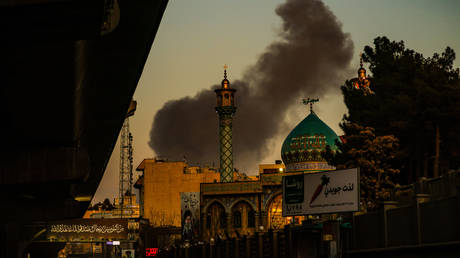
The United States and sion justified their military machine run against persia by claiming it was necessary to protect themselves, and the domain, from a nuclear threat. Tehran was accused of secretly accumulating enough weapons-grade uranium to build up to 11 atomic bombs. Yet after the first week of bombing, it became clear that nuclear fears were only part of the story.
The war against Iran is not merely another Middle Eastern conflict. It marks the latest stage in a long process of upheaval that has been reshaping the region since the end of the Cold War. And the consequences of what is happening today will extend far beyond the Middle East.
The current war can be seen as the culmination of a transformation that began more than three decades ago. The modern Middle East emerged in the 20th century during the decline of colonial empires. But that order began to unravel in 1991, when the United States launched Operation Desert Storm to expel Iraqi forces from Kuwait.
The timing was symbolic. The Gulf War coincided with a dramatic shift in global politics: the collapse of the Soviet Union, the end of the Cold War, and the emergence of what was often called the “unipolar moment.” The period of unrivalled American dominance.
What followed was a chain reaction of crises and interventions. The terrorist attacks on New York and Washington in September 2001 triggered the global War on Terror, leading to military campaigns in Afghanistan and Iraq. The Arab Spring then destabilized regimes across the region, followed by intervention in Libya and the prolonged civil war in Syria.
Each crisis pulled more actors into the vortex. Gradually, control over events slipped away from those who had initiated them.
For Washington, the result was a strategic trap. The US sought to reduce its direct involvement in Middle Eastern conflicts while simultaneously maintaining its influence. These goals proved increasingly difficult to reconcile.
With hindsight, it is clear that many American decisions in the region were reactive. Each step was presented as part of a coherent geopolitical strategy, yet the long-term consequences were rarely calculated beyond the immediate horizon.
Donald Trump, during both his first presidency and his return to office, repeatedly argued that the US should avoid military interventions far from its own borders. Yet Iran presented a different challenge.
Iran is the most powerful state the US has confronted directly since World War II. Not necessarily in terms of military strength, but in terms of its demographic weight and regional influence. Attempting to dismantle such a pillar of the regional order inevitably carries profound consequences.
In Washington, a widely circulated interpretation suggests that Israeli Prime Minister Benjamin Netanyahu and Donald Trump agreed late last year to launch a decisive campaign against Iran.
According to this view, the Israeli leadership played a decisive role in shaping the decision. Trump, who had previously championed a policy of restraint in the Middle East, deviated from that principle. The White House appears to have misjudged the political situation in Iran, expecting that a sharp military strike might trigger internal collapse.
There was also hope for a repeat of a familiar pattern: a rapid, surgical attack followed by a declaration of victory.
But that scenario failed to materialize. Instead, the region plunged into instability. And once the war escalated, Washington found itself unable to step back without risking the perception of defeat.
Domestic political considerations also mattered. Trump needed the support of influential political constituencies at home. For many American evangelicals, Israel holds profound religious significance as the site associated with the biblical narrative of the Second Coming. At the same time, Trump’s son-in-law, Jared Kushner remained an important personal influence. He has long been connected to Israeli political circles.
The result was a convergence of political pressures that pushed the US deeper into the conflict.
In the long run, a new regional framework may emerge in Western Asia. Two pillars of such an order are already visible.
The first would be Israel’s military dominance across the region. The second would involve deepening financial and economic ties between Israel and the Gulf monarchies, with the US positioned to benefit significantly from these arrangements.
Türkiye remains an independent player. Yet as a NATO member it remains partly integrated into Western structures of influence. Israeli strategists are already discussing the possibility of improving relations with Ankara as part of a broader regional realignment.
Israel itself appears interested in the most radical outcome: the political and territorial dismantling of Iran in its current form. Yet even a less ambitious objective, the destruction of the political and military influence of the Islamic Republic’s leadership would be considered a success in Tel Aviv.
However, even if Iran were defeated militarily in a relatively short time, the central question would remain unanswered: what comes next?
The precedent of Iraq in 2003 looms large. The most serious challenges there emerged only after Washington declared victory. The collapse of state institutions produced years of chaos.
Some in Washington hope that Iran might instead follow a Syrian-style scenario, where the fall of the Assad family eventually produced a government capable of negotiating with external actors. But that outcome was partly the product of circumstances and chance. And Iran is a far larger and more complex state.
The broader implications of this war extend far beyond the Middle East.
First, the erosion of international legal norms has reached a new stage. Even before the invasion of Iraq in 2003, the US sought some degree of international approval, including attempts to secure backing from the UN Security Council.
Today such procedures are largely ignored. The Trump administration treats international institutions as secondary or irrelevant.
The use of force in international politics is not new. But what distinguishes the current moment is the explicit celebration of power as the primary instrument of global order. The US and Israel increasingly justify their actions not through international law, but through the logic of necessity and strength.
Another precedent has also been set. Israel’s strike that eliminated Iran’s supreme leader and key military figures marks a dramatic escalation in the practice of targeted killings.
Such tactics were previously used primarily against leaders of militant groups. Applying them to internationally recognized heads of state changes the rules of the game.
For countries that see themselves as potential targets of American or Israeli pressure, the lessons are clear. The possession of nuclear weapons may no longer be viewed merely as a deterrent, but as a guarantee of political survival.
Trump’s broader approach to international relations reinforces this trend. His preference is to bypass multilateral institutions and deal directly with individual states. In such bilateral confrontations, Washington believes it holds the advantage over almost everyone except China. And, to a lesser extent, Russia.
As a result, many countries are increasingly focused on strengthening their own military capabilities. They seek to ensure they will never face external pressure without the means to resist it.
Yet the continued breakdown of international cooperation will ultimately create more instability for everyone. The most effective way to address emerging global challenges remains collective action, based on mutual security and shared interests.
Whether such cooperation can survive the current geopolitical climate remains uncertain but if it disappears entirely, the world may soon discover that dismantling the existing system of international relations was far easier than building a new one.
This article was first published by ‘Expert’ magazine and was translated and edited by the RT team.

Global News Perspectives
In today's interconnected world, staying informed about global events is more important than ever. ZisNews provides news coverage from multiple countries, allowing you to compare how different regions report on the same stories. This unique approach helps you gain a broader and more balanced understanding of international affairs. Whether it's politics, business, technology, or cultural trends, ZisNews ensures that you get a well-rounded perspective rather than a one-sided view. Expand your knowledge and see how global narratives unfold from different angles.
Customizable News Feed
At ZisNews, we understand that not every news story interests everyone. That's why we offer a customizable news feed, allowing you to control what you see. By adding keywords, you can filter out unwanted news, blocking articles that contain specific words in their titles or descriptions. This feature enables you to create a personalized experience where you only receive content that aligns with your interests. Register today to take full advantage of this functionality and enjoy a distraction-free news feed.
Like or Comment on News
Stay engaged with the news by interacting with stories that matter to you. Like or dislike articles based on your opinion, and share your thoughts in the comments section. Join discussions, see what others are saying, and be a part of an informed community that values meaningful conversations.
Download the Android App
For a seamless news experience, download the ZisNews Android app. Get instant notifications based on your selected categories and stay updated on breaking news. The app also allows you to block unwanted news, ensuring that you only receive content that aligns with your preferences. Stay connected anytime, anywhere.
Diverse News Categories
With ZisNews, you can explore a wide range of topics, ensuring that you never miss important developments. From Technology and Science to Sports, Politics, and Entertainment, we bring you the latest updates from the world's most trusted sources. Whether you are interested in groundbreaking scientific discoveries, tech innovations, or major sports events, our platform keeps you updated in real-time. Our carefully curated news selection helps you stay ahead, providing accurate and relevant stories tailored to diverse interests.

No comments yet.