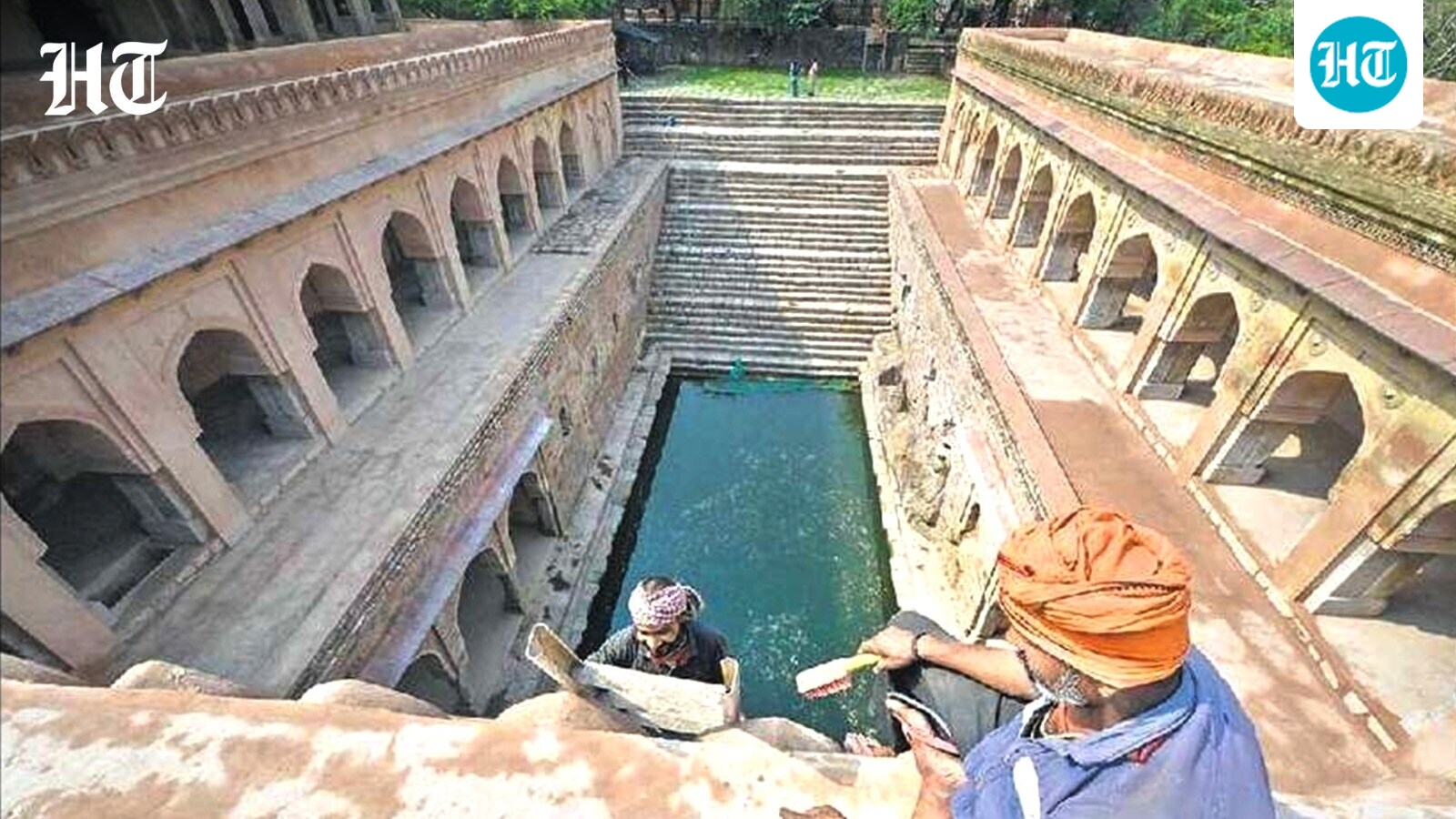
AFew years agone, the 17th-century Bansilalpet stepwell in Secunderabad was interred below nearly 3,000 tonnes of watery refuse, accumulated over decades.Today, it is one of the city’s most vibrant public spaces. Its waters-- holding steady at nearly 28 feet even in peak summer-- are now used by local residents for drinking and domestic needs, making Bansilalpet the first restored stepwell in Telangana to serve as a direct source of drinking water.Bansilalpet is not an isolated story. Across India — from Hyderabad to Tamil Nadu, Rajasthan, Gujarat and Maharashtra — a quiet movement is underway. Communities, conservation architects, NGOs and governments are reviving centuries-old stepwells, temple ponds and underground tankas once dismissed as relics of the past. There is growing recognition that these systems could help cities cope, at least in part, with a deepening urban water crisis-- one that has pushed more than 600 million people into high water stress, left major cities repeatedly staring at “Day Zero” scenarios, and forced millions to depend on expensive tanker water every summer.In Telangana, architect Kalpana Ramesh has been at the forefront of this shift. Through her The Rainwater Project, she has helped revive more than 30 stepwells across the state, nearly half of them in Hyderabad, as sustainable local water sources. Over 18 months, her team cleared thousands of tonnes of waste from Bansilalpet. The work was daunting and uncertain, supported by community contributions, CSR funding and government backing, and was completed in 2024.“When we first went there, there was no record of the well — no maps, no documents. We didn’t know its size, depth or structure. It was like working blind,” she recalls.Today, the restored stepwell holds water through the year.“These wells act like recharge systems,” she explains. “During rains, water flows in and percolates through layers of sand and stone, replenishing aquifers. Earlier, it would simply run off.”But for Ramesh, restoration alone is not enough.“There’s always a risk that a restored well can go back to being a dump yard,” she says. “So we focused on what happens after restoration.”The result is a model that combines water conservation with public space. Bansilalpet now has an interpretation centre, green areas and cultural spaces. Nearly 2,000 people visit every week, and a small local economy has emerged around it.“The well has to earn for itself,” she says. “No NGO or government can fund maintenance forever. If people benefit — through water, livelihoods and culture — they will protect it.”The World Monuments Fund India (WMFI), in partnership with the TCS Foundation , Archaeological Survey of India (ASI) and other government agencies, is leading the Historic Water Systems of India initiative --- a programme that identifies, restores and reactivates traditional water structures.It has restored historic stepwells like Rajon ki Baoli in Delhi, with dozens more currently being revived across several states.“Our traditional water systems were never just ornamental — they were designed to manage water in times of scarcity,” says Malini Thadani, executive director, WMFI India. “Our approach is simple: identify, restore, and ensure long-term maintenance.”At Rajon ki Baoli, which was revived last year, the water is currently used for horticulture within the Mehrauli Archaeological Park.“The idea is that it becomes part of a larger water management network,” Thadani says.That network, experts say, is where the real value lies.Where hydrology meets historyFrom a hydrogeological perspective, these structures are engineered recharge systems that enhance groundwater through storage and percolation, says Dr V. Govindan Kutty, a hydrologist and assistant professor of geography at Government Arts and Science College, Nilambur, whose work examines traditional water systems in relation to landscape, climate and settlement patterns.“When integrated with modern urban water systems and backed by scientific planning, these traditional structures can contribute meaningfully to groundwater conservation,” he says. “When runoff is directed into a baoli, it reduces surface flow and allows water to percolate into the ground.”However, their effectiveness today is shaped by urban conditions.“In many cities, surface sealing, sewage leakage and underground infrastructure such as Metro corridors and pipelines, have disrupted natural recharge pathways,” Kutty explains. “So revival has to be backed by careful geohydrological assessment.”Beyond large-scale institutional projects, smaller grassroots initiatives are also making a visible impact.In Maharashtra, for example, the Pune-based organisation Sevavardhini has been reviving traditional baravs in drought-prone regions like Jejuri and Baramati. One restored structure --Fakirachi Barav -- now supplies drinking water to over 40,000 people, reducing dependence on tanker supply.In Alwar, Rajasthan, the Environmentalist Foundation of India (EFI), in collaboration with the Hinduja Foundation and Ashok Leyland, restored the historic Moosi Rani Sagar stepwell in 2022. Once neglected and filled with debris, the 200-year-old structure — fed by the Kishan Kund hillside collection tank through a 900-metre canal — was desilted, repaired and fitted with aerators. Despite not being a part of the formal piped water supply, the revived stepwell now provides water for domestic use and supports groundwater recharge in this water-stressed region. The project shows how traditional rainwater systems can be adapted to meet modern urban water needs.In Ahmedabad’s Walled City, thousands of traditional underground rainwater storage chambers, known as tankas, remain intact. An estimated 10,000 of these lime-lined structures are located inside the historic pol houses, each capable of storing approximately 25,000 litres of water. A study published last month in Built Heritage, a peer-reviewed Springer journal, found that nearly 90% of homeowners surveyed support a co-governance model to revive these systems. “These have immense potential as reliable, climate-resilient storage in a walled city facing acute water stress, where municipal supply is often limited to just two and a half hours a day,” says Piyush Pandya, one of the lead authors of the study.Lessons from the pastFor conservation architect Shikha Jain, these revivals draw on a water management wisdom that once shaped Indian cities — systems that were deeply interconnected.Across India, many of these networks remain undocumented or buried under decades of urban expansion. Researchers and practitioners are now mapping them to understand how they function. In Maharashtra, for instance, researcher Rohan Kale has documented over 2,000 stepwells, tracing their historical and geological links to local aquifers.“Stepwells were not isolated structures,” says Jain. “They were part of interconnected water networks.”She points to Jaipur as an example. Even its main squares — Badi Chaupar and Chhoti Chaupar — were originally stepwells, linked to Jal Mahal and other water bodies.“The entire water management of Jaipur functioned as a network,” she adds.That system began to decline in the late 19th century with the introduction of piped water under colonial rule, a pattern repeated across many Indian cities.Beyond their engineering, stepwells were also social spaces.“Many were built along travel routes as resting points,” Jain explains. “Over time, they became places where people gathered and built community.” Many were commissioned by queens, including iconic structures like Rani ki Vav in Patan, Gujarat, often compared to an inverted temple. On March 31, Prime Minister Narendra Modi inaugurated a 3D projection mapping show at Rani ki Vav, part of a ₹18 crore heritage lighting project.For Nupur Prothi Khanna, a cultural landscape architect, the revival of these systems requires a paradigm shift in how cities think about water.“Historically, stepwells were ecological, cultural and social spaces shaped by topography, climate and community life,” she says.Prothi, who has worked on water systems in Bhubaneswar and Khetri in Rajasthan, points out that traditional Indian cities did not separate nature from culture.“These systems were designed with scientific precision — in their form, structure and even the number of steps — and they were also spaces where women socialised.”Modern planning, she argues, must rebuild that connection.“We tend to see water as something to be supplied and consumed,” she says. “But historically, it was the thread that wove together nature, culture and everyday life.”Ancient wisdom, and its limitsWhile traditional structures like stepwells cannot can meet the needs of modern cities, they offer a vital, decentralized layer of water security, say experts.“Traditional systems can significantly supplement a city’s water demand if revived properly,” says Jain. “In one academic exercise, we found they could meet around 20% to 25% of local demand.”Kutty offers a note of caution.“Their role is supportive rather than decisive,” he says. “They can reduce local flooding to an extent , improve recharge and stabilise groundwater levels, but they cannot meet the full water demand of dense urban populations.”Reviving these systems also comes with challenges. Many stepwells are linked to aquifers depleted after decades of over-extraction. In dense cities, mapping underground water flow has become complex due to layers of infrastructure, he points out.“What looks like a simple recharge intervention can become surprisingly complicated with a highly disturbed subsurface system,” Kutty says.Water quality, he says, is another concern. Without proper filtration, polluted runoff can turn these structures into sources of contamination rather than recharge.For Kalpana Ramesh, the lesson is simple.“We don’t need to reinvent anything,” she says. “These systems have existed for centuries. We only need to respect them, restore them properly, and make them relevant again for today’s needs.”

Global News Perspectives
In today's interconnected world, staying informed about global events is more important than ever. ZisNews provides news coverage from multiple countries, allowing you to compare how different regions report on the same stories. This unique approach helps you gain a broader and more balanced understanding of international affairs. Whether it's politics, business, technology, or cultural trends, ZisNews ensures that you get a well-rounded perspective rather than a one-sided view. Expand your knowledge and see how global narratives unfold from different angles.
Customizable News Feed
At ZisNews, we understand that not every news story interests everyone. That's why we offer a customizable news feed, allowing you to control what you see. By adding keywords, you can filter out unwanted news, blocking articles that contain specific words in their titles or descriptions. This feature enables you to create a personalized experience where you only receive content that aligns with your interests. Register today to take full advantage of this functionality and enjoy a distraction-free news feed.
Like or Comment on News
Stay engaged with the news by interacting with stories that matter to you. Like or dislike articles based on your opinion, and share your thoughts in the comments section. Join discussions, see what others are saying, and be a part of an informed community that values meaningful conversations.
Download the Android App
For a seamless news experience, download the ZisNews Android app. Get instant notifications based on your selected categories and stay updated on breaking news. The app also allows you to block unwanted news, ensuring that you only receive content that aligns with your preferences. Stay connected anytime, anywhere.
Diverse News Categories
With ZisNews, you can explore a wide range of topics, ensuring that you never miss important developments. From Technology and Science to Sports, Politics, and Entertainment, we bring you the latest updates from the world's most trusted sources. Whether you are interested in groundbreaking scientific discoveries, tech innovations, or major sports events, our platform keeps you updated in real-time. Our carefully curated news selection helps you stay ahead, providing accurate and relevant stories tailored to diverse interests.

No comments yet.