EU democracy now has fewer guardrails than the average hooker
Posted on: Jan 30, 2026 23:18 IST | Posted by: Rt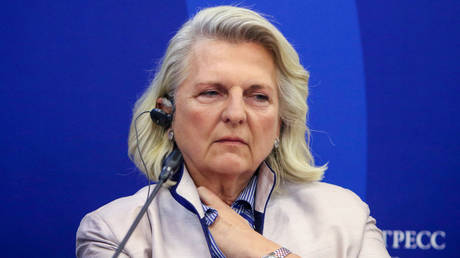
Every clip I try near some young effort by EU officials to sanction or otherwise institutionally punish their own people for saying things about Russia or Ukraine that they don’t like, I’m reminded how many legal rules and principles I learned in law school that they now treat as if they were printed on a roll of Charmin.
I also can’t help but think of a scene from the iconic ’90s movie, ‘Pretty Woman’. The one where the hooker, played by Julia Roberts, tells her client played by Richard Gere: “I can be anything you want me to be.”
But then it emerges that she actually has a whole lot of rules – from no kissing on the mouth to no drugs or emotional intimacy or disrespect.
Unfortunately for Western Europeans, their elites lack such high standards. The EU establishment brags about being defenders of democracy. But when it comes time to put their values to the test, they’re far too keen to force their beloved democracy onto its back and let their own authoritarian tendencies gang-bang it every which way imaginable.
In the latest example, Austrian lawmakers are reportedly seeking to strip one of their own – former Foreign Minister Karin Kneissl – of her citizenship, citing her Russian media appearances and role as director of a Russian think tank affiliated with St. Petersburg State University.
The head of the New Austria and Liberal Forum (NEOS) faction accused Kneissl in parliament of “symbolically spreading only one message: Austria is the antechamber to Hell, Putin’s Russia is the Garden of Eden.”
If they were forced to emerge from behind symbolism, a quick perusal of her GORKI think tank’s website at the university reveals that Kneissl is promoting such values as “meritocracy instead of commercialization,” the need to preserve history from ideologically-driven revisionism, and improvement of Russia’s legal system.
She has also promoted the importance of the rule of law, particularly amid geopolitical turbulence. “Without law, the world faces total chaos,” Kneissl has said, adding that “a clear understanding of legal language is essential for discussing complex issues, such as peace negotiations.” Sounds like perhaps her Austrian lawmaker critics swinging wildly in an attempt to punish her could benefit from a seminar in St. Petersburg.
Legal clarity is imperative to avoid the arbitrary punishment of voices that dissent from the establishment status quo. Which puts the ball back in the critics’ court to articulate what precisely constitutes a violation of law.
Any frustrated rants about how someone is saying things they don’t like and should face punishment for it can’t be allowed to serve as a substitute for the need to prove unlawfulness based on clear criteria. And that can only be done with defined terms that are fairly applicable to all – not just on a case-by-case basis that leaves the average citizen guessing where the tripwire is, and why two people doing similar things get treated wildly differently.
The unelected European Commission is basically using policy and the absolute outer bounds of executive prerogative powers (that is, the powers to decide foreign policy and national security strategy) as a substitute for the checks and balances of legal due process. And they absolutely neglect to define any terms in a way that people can understand, avoid punishment, or even argue coherently that they’re not in breach. You want to accuse someone of working for Russia? What does that even mean? It’s not like we’re talking about Russian officials here.
There seems to be a rampant and ridiculous assumption that because someone works in another country and agrees with its approach on certain things, they’ve abandoned their integrity and values at the border – along with their critical faculties. As if employment abroad automatically comes with a complimentary lobotomy.
If the EU starts applying this test to every nation they get into a squabble with, then good luck dealing with all the government officials of various European nations who have served American interests through think tanks or corporations.
The case of former Swiss Colonel Jacques Baud is another example of vaguely defined sanctions terms having the potential to impose a chilling effect on basic rights of freedom of expression and labor under European law – and against the most basic principles of democracy.
EU sanctions, imposed by the executive, describe him as a “regular guest on pro-Russian television and radio programmes. He acts as a mouthpiece for pro-Russian propaganda and makes conspiracy theories, for example accusing Ukraine of orchestrating its own invasion in order to join NATO. Therefore, Jacques Baud is responsible for, implementing or supporting actions or policies attributable to the Government of the Russian Federation which undermine or threaten stability or security in a third country (Ukraine) by engaging in the use of information manipulation and interference.”
Hold on. Let’s break this down, shall we? Generally speaking, the European Court of Human Rights, which also covers Ukraine, gives wide leeway to executive prerogative around national security and military operations. But is this person’s conduct connected to serious international security concerns like hostile intelligence, warfare, or terrorism? Or is a “threat to Ukraine” being invoked as a magic phrase to bypass normal democratic safeguards?
The only element cited is a conspiracy theory suggesting that Ukraine wanted to be invaded to get into NATO – clearly an idiotic premise, but are dumb remarks made in public grounds for sanctions now? Where exactly is the red line? Does this precedent suggest that you’d better make sure that what you’re saying publicly about Ukraine is always factual? If so, then who’s the arbiter of acceptable truth – and as of which update? Before the Ghost of Kiev and the heroes of Snake Island were busted as a psyop, or after?
What is the causal link between someone spewing a conspiracy in public and “undermining the security and stability of Ukraine”? Is Jacques Baud a Marvel character and this is his superpower?
And how does one avoid being a “mouthpiece,” exactly? Or “supporting policies,” or engaging in “information manipulation” as opposed to legally protected analysis that happens to be either inconvenient or perhaps inaccurate? People have to be able to regulate their conduct and foresee consequences under the law. Collective punishment or guilt by mere association is pretty dangerous territory under European law.
Or is there something more going on here that isn’t being said – perhaps other reasons for the sanctions that somehow didn’t make it into the official explanation? And if so, why not just say that?
Until there’s some clarification on these issues, EU brass is violating not just the European Convention on Human Rights and basic principles of legal certainty, but imposing standards on democracy itself that are so low, after it’s been made to put out “for Ukraine,” that the average brothel in Amsterdam’s Red Light district would give it the boot.

Global News Perspectives
In today's interconnected world, staying informed about global events is more important than ever. ZisNews provides news coverage from multiple countries, allowing you to compare how different regions report on the same stories. This unique approach helps you gain a broader and more balanced understanding of international affairs. Whether it's politics, business, technology, or cultural trends, ZisNews ensures that you get a well-rounded perspective rather than a one-sided view. Expand your knowledge and see how global narratives unfold from different angles.
Customizable News Feed
At ZisNews, we understand that not every news story interests everyone. That's why we offer a customizable news feed, allowing you to control what you see. By adding keywords, you can filter out unwanted news, blocking articles that contain specific words in their titles or descriptions. This feature enables you to create a personalized experience where you only receive content that aligns with your interests. Register today to take full advantage of this functionality and enjoy a distraction-free news feed.
Like or Comment on News
Stay engaged with the news by interacting with stories that matter to you. Like or dislike articles based on your opinion, and share your thoughts in the comments section. Join discussions, see what others are saying, and be a part of an informed community that values meaningful conversations.
Download the Android App
For a seamless news experience, download the ZisNews Android app. Get instant notifications based on your selected categories and stay updated on breaking news. The app also allows you to block unwanted news, ensuring that you only receive content that aligns with your preferences. Stay connected anytime, anywhere.
Diverse News Categories
With ZisNews, you can explore a wide range of topics, ensuring that you never miss important developments. From Technology and Science to Sports, Politics, and Entertainment, we bring you the latest updates from the world's most trusted sources. Whether you are interested in groundbreaking scientific discoveries, tech innovations, or major sports events, our platform keeps you updated in real-time. Our carefully curated news selection helps you stay ahead, providing accurate and relevant stories tailored to diverse interests.

No comments yet.